
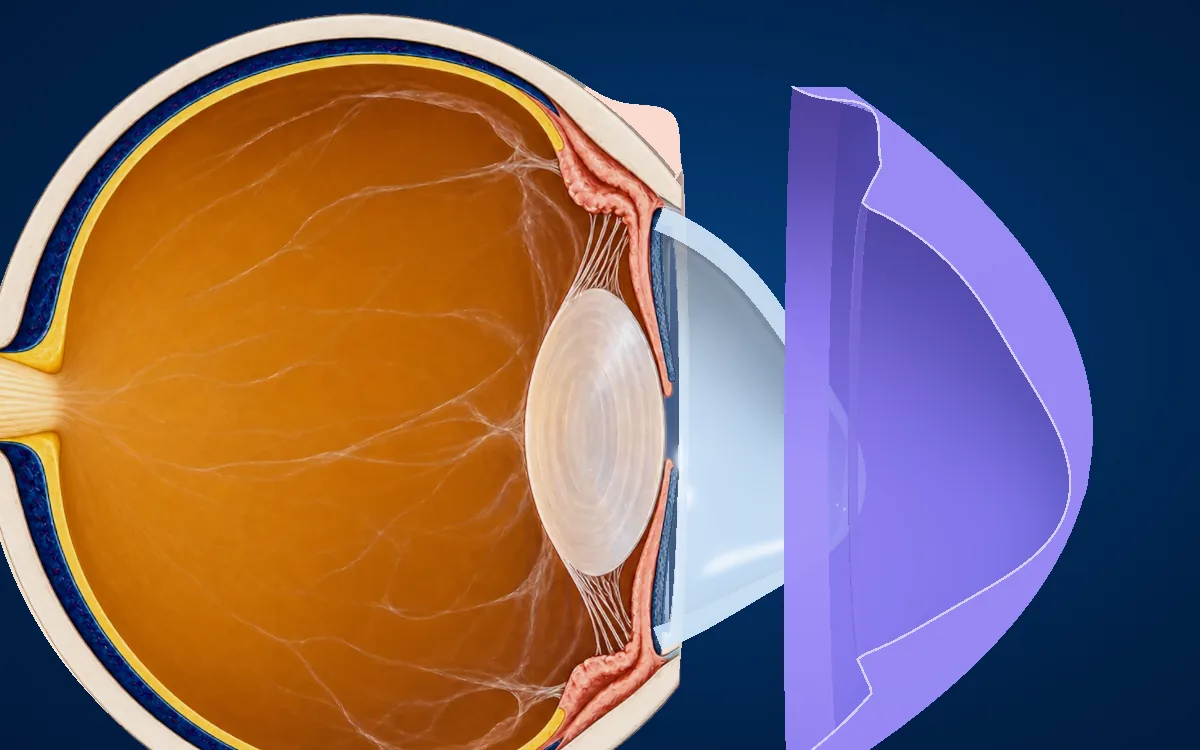
What an impression-based scleral lens is
Most scleral lenses are fitted with trial lenses. Your fitter places lenses of known shape on your eye, watches how they sit, and orders a lens with changes. An impression-based lens takes a different route: the fitter takes an impression of the front of your eye, the mold is scanned with a 3D scanner, and the lens is cut on a lathe to match it.[2]
Because the lens is shaped from your own eye, its edge can follow features that standard designs struggle with, such as an unevenly shaped white of the eye or the bump of a glaucoma drainage device.[4] Like any scleral lens, it still vaults over the cornea (the clear front window of the eye) and rests on the white of the eye on a layer of saline. If you’re new to how that works, start with how scleral lenses work.
EyePrintPRO is the impression-based lens most of the published research describes, and it’s the one this page is about. We name it only so you can recognize what you’ve been offered.
FDA status
EyePrintPRO lenses were cleared by the FDA through the 510(k) process on April 27, 2016, under number K152724. They are regulated as a Class II rigid gas permeable contact lens, the same category as other gas permeable lenses, not as a separate kind of device. The FDA summary describes a rigid gas permeable lens “designed from measurements of the ocular surface obtained by the EyePrint Impression Process”, lathe-cut from roflufocon D, a gas permeable lens material.[1]
The cleared use is daily wear. The summary says the lenses may be prescribed for eyes that need a rigid gas permeable lens to manage irregular corneal conditions, such as keratoconus, pellucid marginal degeneration, or after a corneal transplant or refractive surgery such as LASIK.[1] A 510(k) clearance means the FDA found the lens substantially equivalent to lenses already on the market. It isn’t a finding that it works better than other scleral lenses.
Who it’s for
Impression-based lenses are mostly a second-line option, for eyes where a standard lens hasn’t worked or can’t sit well.
- People who’ve had trouble with standard sclerals. In a review of 44 patients (70 eyes) at three specialty practices, 29 patients had already tried standard scleral lenses without success. The main reasons for the lenses were an irregular cornea (44 eyes) and ocular surface disease (26 eyes).[3]
- An unevenly shaped white of the eye. The sclera, the white of the eye where a scleral lens lands, is rarely evenly round. A survey paper summarizing earlier measurements notes that only a small share of scleras are spherical, most are toric or have high and low points, and the asymmetry is reported to be greater in keratoconus.[6] A standard lens edge can press on a high point and lift off a low one. Many of these eyes do well with a toric landing zone or a scan-based design; an impression is another route.
- Raised areas on the white of the eye. In a study of 95 eyes fitted with EyePrintPRO, 8 eyes (8%) were fitted because of features beyond the cornea, such as glaucoma drainage devices, that stopped a standard lens from fitting.[4] No study we found looked at impression-based lenses for a pinguecula specifically; for that, see scleral lenses with a pinguecula.
- After glaucoma surgery. A trabeculectomy bleb or a drainage tube sits near the edge of the cornea, right where a scleral lens lands. A 2025 review lists impression-based landing zones among the ways fitters keep a lens off them.[12] In a 15-year series from one academic center, 4 of 5 eyes fitted with impression-based scleral lenses after bleb-forming surgery wore them successfully for a year, compared with 1 of 9 eyes in scleral lenses that weren’t impression-fitted. The numbers are very small.[11] Our page on scleral lenses with glaucoma covers blebs and tubes in more detail.
- Other surface disease. The same 95-eye study also included ocular surface disease, exposure of the cornea, and neurotrophic keratitis.[4]
How it’s made, step by step
These are the seven steps in the animation above, with what the published sources say about each. Where only the maker describes a detail, we say so and leave it out.
1. A mold, not trial lenses
Instead of a set of trial lenses, the fitting starts with an impression of the front of your eye.[2] In the multicenter review, the visit to take the impression counted as part of the fitting.[3]
2. Not every eye is the same shape
The lens is designed to fit the shape it finds: the cone of an irregular cornea, the curve of the white of the eye, and any raised areas. That’s the main reason to choose this route over a lens chosen from standard shapes.[4]
3. Taking the impression
An ocular impression uses a soft material that molds to the shape of the eye and then quickly sets as a negative image of the surface. Impressions of the eye have long been used to make custom scleral lenses and artificial eyes.[9] For EyePrintPRO, the FDA summary names the material: a vinyl polysiloxane, a silicone impression material, which has its own FDA clearance.[1]
What we could confirm about safety. In the testing summarized for the FDA, tear stability, redness and staining of the eye’s surface were checked before and after the impression in 8 people, with no significant changes.[1] That’s a small, sponsor-run test. In a separate research study comparing two impression materials in 20 people, vision wasn’t affected, tear stability was only marginally disturbed, and redness increased with both materials; the silicone-type material caused less surface staining than the other.[10]
What we couldn’t confirm. No peer-reviewed or FDA source we found describes whether numbing drops are used, how the material is applied and held, how long it takes to set, or where you look while it does. Those details appear only in the maker’s own patent, which isn’t evidence of how clinics do it today, so we’ve left them out. Ask your fitter to walk you through their routine.
4. A negative of your eye
Once set, the mold comes away holding a negative of the eye’s surface.[9] Research protocols sometimes make a stone cast from the mold before measuring it; we found no source describing that step for EyePrintPRO.
5. Scanned in 3D
The mold is scanned with a 3D scanner, turning its shape into a digital map of the front of your eye.[2]
6. A lens cut to match
The lens is designed from that map and cut on a lathe from gas permeable lens blanks.[1][2] Its back surface follows the white of the eye, raised areas included, while the center arches over the cornea. One glaucoma paper describes impression-fitted lenses as 3D printed,[11] but the FDA summary and a 2025 review describe lathe-cutting, so that’s what we show.
7. Fitted over a few visits
The lens goes on filled with saline, like any scleral lens, and your fitter checks the fit and your vision over follow-up visits. Sometimes the lens is adjusted, and sometimes a new impression is needed (see below).[3][4]
Fitting visits and remakes
- Visits. In the multicenter review, completing the fitting took an average of 4 visits, including the visit to take the impression.[3]
- Time. In a survey of 423 practitioners who fit scleral lenses for keratoconus, taking impressions took a median of 15 minutes. The median first visit (30 minutes) and the median number of lenses ordered (2) were the same whether the fitter used trial lenses, scans or impressions.[7]
- Remakes. The same practitioners said the first impression was good enough to order a lens a median of 90% of the time.[7] In the 95-eye study, 14 eyes (14.7%) needed a new impression and lens. Of the 56 eyes that had already failed standard scleral lenses, 12 needed one.[4]
We found no published source for how long it takes to get the lens back after the impression, so ask your practice. For what’s normal with any scleral lens, see how many remakes is normal? and how long it takes to get scleral lenses.
What the studies show
All of the published studies are small and look back at patient records. None compares impression-based lenses with another approach in the same people.
- Vision. In the 95-eye study, median vision with each patient’s usual correction improved from about 20/94 to about 20/24 with the impression-based lens.[4] In a study of 14 eyes, average best-corrected vision went from 20/36 to 20/21.[5] Vision also improved significantly compared with patients’ previous correction in the multicenter review.[3]
- Fit. In the multicenter review, the lens edge sat in ideal alignment on the white of the eye in 74% of fits, and the lens fully cleared the limbus (the border between the cornea and the white) in 83%.[3]
- After failed standard lenses. Of 56 eyes that had previously failed standard scleral lenses, 49 were still wearing impression-based lenses at the end of follow-up.[4]
- Comfort. In the 14-eye study, every patient reported less dryness, redness and pain, and 6 of 7 people who had worn lenses before found these more comfortable and could wear them all day. Two still had fogging and needed to clean the lens after 4 to 6 hours.[5]
These numbers come from specialty practices that chose people they thought would benefit, so they can’t tell you how likely you are to succeed.
Limitations and risks
- The usual scleral lens problems still happen. In the 95-eye study, followed for a median of about a year, a third of eyes (33.1%) had adverse wear symptoms and 16% had adverse signs. Wear stopped in 10 eyes (10.5%).[4] In the multicenter review, 2 eyes stopped because of complications.[3] See are scleral lenses safe?
- A custom fit isn’t guaranteed. Some eyes needed a new impression, and in the multicenter review the edge wasn’t in ideal alignment in about a quarter of fits.[3][4]
- It’s not widely available. Practitioners who had impression-based technology used it for a median of 8% of their keratoconus fits, and it was more often found in academic and high-volume practices.[6] That can mean travel. See is it worth traveling for a fitting?
- The evidence is thin. The outcome studies are small and retrospective, and the first author of the case report on adding wavefront-guided optics reports honoraria from the maker.[14]
- Scleral lens limits in general. A 2025 review notes that resource demands on practices, difficulty with insertion and removal, midday fogging and corneal swelling remain challenges with scleral lenses, advanced designs included.[13]
How it compares with other ways to shape a lens
There are several ways to get a scleral lens that fits an uneven eye. A 2025 review lists customized landing zones, topography- and profilometry-based fitting, and impression-based design as ways to achieve a fit in difficult eyes.[13] In an international survey of 715 practitioners, toric landing zones were the most prescribed (48%), then spherical (40%), quadrant-specific (8%), and impression- or image-based designs (3%).[8]
| Approach | How the shape is found | Often used for | Read more |
|---|---|---|---|
| Standard trial-lens fit | Lenses of known shape tried on the eye, then adjusted | Most eyes | What a fitting involves |
| Toric or quadrant-specific landing zone | Trial lenses with an edge that differs around the lens | Scleras that aren’t evenly round | Toric landing zones |
| Scan-based (profilometry) | An optical scan of the cornea and sclera | Irregular scleras, hard fits | Scleral profilometry |
| Impression-based | A physical mold of the eye, scanned in 3D | Failed standard fits, raised areas, glaucoma devices | This page |
| PROSE | A treatment program with its own design software | Severe surface disease, complex eyes | What is PROSE? |
The uses listed come from the reviews and studies cited on this page.[13][4] In the practitioner survey, a first visit took about the same time and the same number of lenses were ordered whichever method was used.[7] For a fuller side-by-side, see impression-based vs scan-based vs PROSE.
Adding custom optics or prism
An impression-based lens can carry extra optics. In a case report, a man with keratoconus who hadn’t managed with a standard scleral lens was fitted with impression-based lenses, then had wavefront-guided optics added using dots on the lens and an aberrometer; his vision improved by two lines in each eye.[14] That technique, and the leftover distortions it targets, is explained in wavefront-guided scleral lenses.
Prism can be built in too. In a series of 7 people with double vision from eye-alignment problems, prism added to impression-based scleral lenses resolved the double vision in all of them.[15] See can scleral lenses fix double vision?
Insurance coverage
In the US, impression-based lenses are billed and covered like other scleral lenses. None of the published payer policies we read treats them as a separate category. Your plan’s own documents decide.
- The lens code. Payers list V2531 for a gas permeable scleral lens, billed per lens.[16] See scleral lens billing codes.
- Medical or vision plan. Aetna, for example, covers gas permeable scleral lenses under its medical plans when they’re used as a bandage for severe ocular surface disease, even under plans that exclude contact lenses. Where a medical plan excludes contact lenses, lenses for keratoconus and other irregular corneas are covered only under the member’s vision care plan.[16] Other plans differ. See medical vs vision insurance.
- Ask before the impression. Ask the practice which codes it will bill and whether your plan needs prior authorization. If a standard lens has already failed, a letter of medical necessity that says so can help.
What people who’ve had it say
This is what members of patient communities said about their own impression-based lenses. It isn’t advice and it isn’t a source, and it doesn’t measure how well the lenses work: the sourced findings are in the sections above. The themes are simply what people brought up, good or bad.
Questions to ask your fitter
- Why do you think an impression-based lens suits my eye better than a trial-lens or scan-based fit?
- Have I tried a toric or quadrant-specific landing zone yet?
- What will the impression feel like, and do you use numbing drops?
- How many visits do you expect, and how long until the lens arrives?
- What happens if the first lens doesn’t fit? Does the fitting fee include a new impression or remakes?
- How many impression-based lenses do you fit?
- If I have a glaucoma bleb or tube, will you work with my glaucoma doctor?
- Which codes will you bill, and will you help with prior authorization?
EyePrintPRO is a trademark of its owner. This site isn’t affiliated with or endorsed by the maker.
Common questions
What is getting an eye impression like? Does it hurt?
No study we found asked patients what it felt like, and the published studies don't say whether numbing drops are used, so ask your fitter what their routine is. The material goes on soft, sets in place on the front of the eye, and is lifted off once firm. In the safety testing summarized for the FDA, tear stability, redness and staining of the eye's surface didn't change significantly after the impression in 8 people. Tell your fitter straight away if anything hurts, and say beforehand if you're anxious so they can talk you through each step.
Is an impression-based lens better than a regular scleral lens?
Not for everyone. Most scleral lenses are fitted with trial lenses and work well. Impression-based lenses are mainly used when the eye's surface is too uneven for a standard design, or when standard lenses haven't worked. No study has compared them head to head with other approaches in the same people.
Will I need more than one impression?
Sometimes. In the largest study, 14.7% of eyes needed a new impression and lens. Practitioners in a survey said the first impression was good enough to order a lens a median of 90% of the time.
Is EyePrintPRO FDA approved?
It was cleared through the FDA's 510(k) process in 2016 (K152724) as a rigid gas permeable contact lens, for daily wear in eyes that need a rigid lens because of irregular corneal conditions such as keratoconus, pellucid marginal degeneration, or a corneal transplant or refractive surgery. Clearance means the FDA found it substantially equivalent to lenses already on the market.
Can an impression-based lens fit around a glaucoma bleb or tube?
It's one of the approaches fitters use. Raised areas such as glaucoma drainage devices were among the reasons for wear in the largest study, and in one small glaucoma series 4 of 5 eyes with impression-fitted scleral lenses wore them successfully for a year. Your fitter and your glaucoma doctor should plan it together.
Does insurance cover impression-based scleral lenses?
None of the published policies we read treats impression-based lenses differently from other scleral lenses. Coverage depends on your diagnosis and plan, so ask your plan about the lens and fitting codes your practice will bill, and whether prior authorization is needed.
With impression-based lenses, does the fitter's skill still matter?
Yes. The fitter takes the impression, and a poor one means a lens that doesn't match your eye or a repeat impression. The fitter also judges how the finished lens sits and how well you see, orders changes to the vault, edge and power, and manages problems such as fogging or discomfort over the follow-up visits. The mold replaces the trial lenses, not the person reading the fit, so ask how many impression-based lenses a practice has fitted.
Can my impression mold be reused, or the lens adjusted without a new mold?
Often the lens can be changed without a new impression. The mold is scanned into a digital map, and the lens is designed from that map, so changes such as the power or how high the lens vaults can be made to the design. A new impression is needed when the first one wasn't good enough, or when your eye has changed, for example after surgery. Ask your practice whether your scan is kept on file and what a remake from it costs compared with a new impression.