
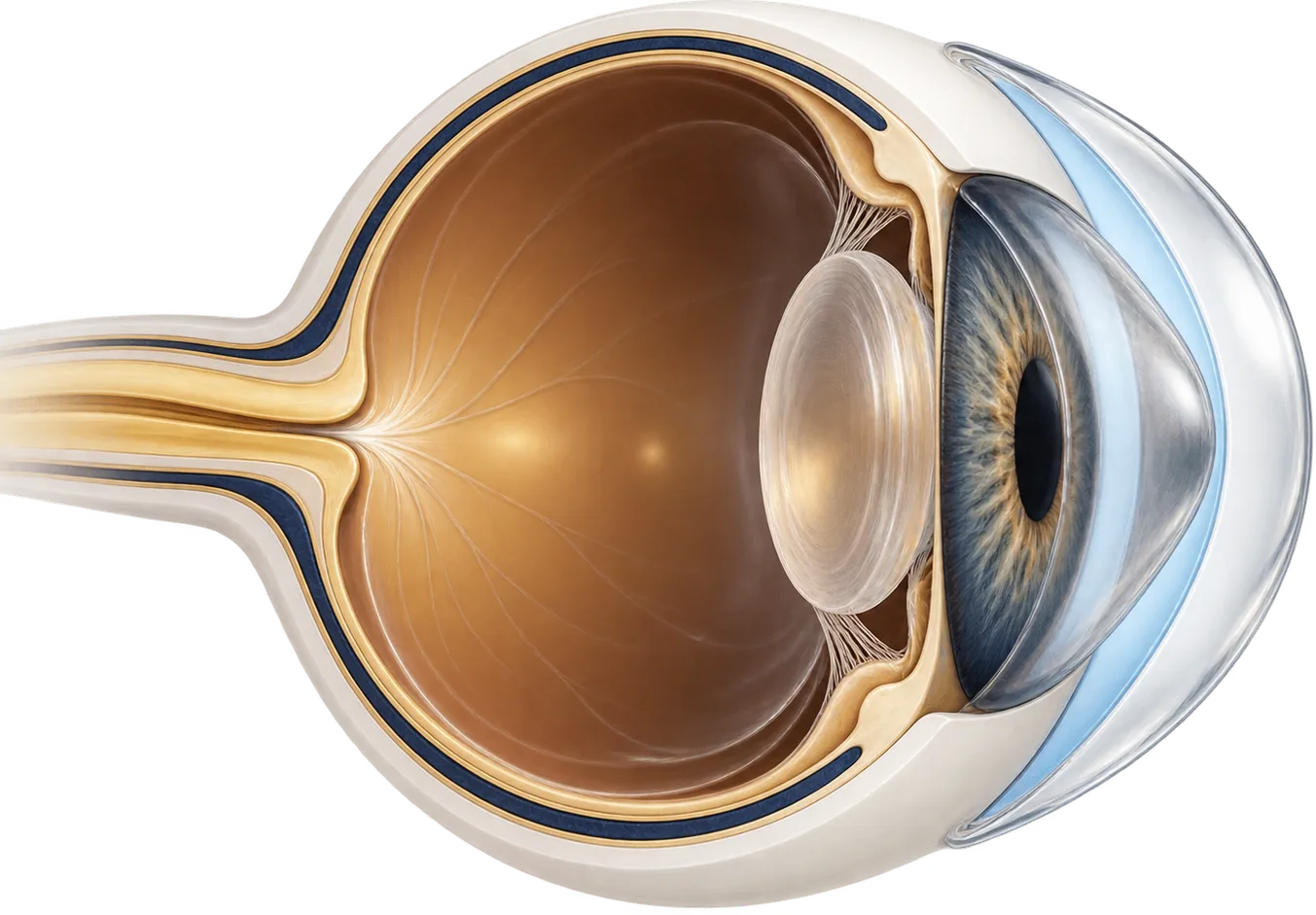
How Sjögren’s syndrome affects the eye and vision
Sjögren’s syndrome (also called Sjögren’s disease) is a chronic autoimmune disease. The immune system attacks the glands that produce moisture, most notably the tear glands and salivary glands. Dry eyes and a dry mouth are its hallmarks, but it can also affect the joints, nerves, lungs, kidneys, and other organs.
In the eye, Sjögren’s is the classic cause of aqueous-deficient dry eye, where the tear glands don’t make enough of the watery part of the tears. The TFOS DEWS II report classifies dry eye as aqueous-deficient or evaporative, while noting that the two exist on a continuum and many people have elements of both.[4] Without enough tears, the front of the eye becomes inflamed and damaged. People describe grittiness, burning, light sensitivity, and vision that blurs between blinks.
The eye problems can be serious. At one US Sjögren’s center, 98% of patients had a history of dry eye, on average 10.4 years before they were seen there. A quarter had eye problems beyond dry eye, and 13% had a vision-threatening finding. Those with vision-threatening eye findings were 3.9 times more likely to have Sjögren’s affecting other parts of the body.[6]
Dry eye is often the first clue. Among 220 patients at one dry eye center, 10.9% had primary Sjögren’s, and only a third of them already knew it when they arrived.[5]
How Sjögren’s is classified. Rheumatologists use the 2016 ACR/EULAR classification criteria, which were built for research and clinical trials. They score five items. A positive anti-SSA (Ro) antibody blood test and a positive salivary gland biopsy score 3 each. Abnormal staining of the eye surface, a Schirmer tear test of 5 mm or less in 5 minutes, and low saliva flow score 1 each. A total of 4 or more meets the criteria in someone with signs or symptoms suggestive of the disease.[1] Two of the five items are measured in the eye, which is one reason eye care providers are often involved in diagnosis.
How common it is depends on how cases are counted. A global review of 21 studies estimated about 61 cases per 100,000 people, and about 43 per 100,000 when only population-based studies were counted. Women outnumbered men by roughly 10 to 1.[2] In Olmsted County, Minnesota, prevalence was 10.3 per 10,000 based on physician diagnosis but only 2.2 per 10,000 based on classification criteria, because the tests the criteria require were rarely done in everyday practice.[3] Estimates vary, so treat any single figure as a rough guide.
How a scleral lens works for Sjögren’s dry eye
A scleral lens is a large rigid gas-permeable lens. It rests on the sclera (the white of the eye) and arches over the entire cornea without touching it. Before insertion the lens is filled with sterile saline, which stays in place between the lens and the cornea while the lens is worn.
In Sjögren’s, the eye can’t make enough of its own tears. The lens compensates in two ways:
- It keeps the cornea bathed. The saline reservoir stands in for the missing watery tears for as long as the lens is in.
- It shields the cornea from the eyelid. Each blink normally drags the lid across a dry, damaged surface. With a scleral lens in, the lid slides over the smooth lens instead.
The fluid layer also smooths out surface damage optically, so many people see more clearly with the lens in.
Where scleral lenses fit alongside rheumatology care
Sjögren’s is a whole-body disease, and scleral lenses address only the eye surface. Care is usually shared: a rheumatologist manages the autoimmune disease, and an eye doctor manages the dry eye. A scleral lens fitter joins that team when the eye stays dry and damaged despite standard treatment.
Consensus guidelines for dry eye in Sjögren’s recommend staging how severe the eye disease is and choosing treatment accordingly. Options include tear supplements, controlling inflammation of the tear glands and eye surface, and stimulating tear production.[7] The broader TFOS DEWS II plan for dry eye places rigid scleral lenses at step 3 of 4, after lubricants, punctal plugs, and prescription medicines, and alongside options such as serum eye drops and oral medicines that stimulate tear production.[8]
It’s worth making sure each member of the team knows what the others are doing. Medicines that affect the immune system or tear production can matter to your eye doctor and fitter.
What the research shows
There are no large studies of scleral lenses in Sjögren’s alone. The evidence comes from case series of people with dry eye and other ocular surface diseases, in which Sjögren’s is one of several causes.
Sjögren’s patients are included in dry eye studies that show benefit. In a Brazilian study of 41 eyes with moderate to severe dry eye, 11 eyes had Sjögren’s. Across the group, scleral lens wear improved vision, reduced tear saltiness and surface staining at 12 months, and improved symptoms and quality-of-life scores.[9]
Most people who complete a fit meet their treatment goals. At the Mayo Clinic, 115 patients with ocular surface disease completed a scleral fit, and all but 2 achieved their goals of better comfort, surface protection, or healing. Average vision improved from about 20/42 to 20/26.[10]
Many keep wearing them long term. In a five-year follow-up, 64% of people treated for ocular surface disease were still wearing their device, fewer than the 84% treated for a distorted cornea.[11]
Other options, compared
Dry eye in Sjögren’s is usually managed with several treatments at once. Scleral lenses add to that plan rather than replacing it.
| Option | What it does | Typically suited to |
|---|---|---|
| Preservative-free lubricating drops and gels | Supplement the missing tears | All stages; the usual starting point |
| Punctal plugs | Keep tears on the eye longer by blocking drainage | Aqueous-deficient dry eye not controlled by drops |
| Prescription anti-inflammatory drops | Reduce inflammation of the eye surface | Moderate disease with inflammation |
| Oral medicines that stimulate tear production | Increase gland secretion | Selected patients, prescribed by their doctor |
| Autologous serum drops | Drops made from the patient’s own blood | Severe disease not controlled by earlier steps |
| Scleral lenses | Hold saline over the cornea and shield it from the lid | Severe disease not controlled by earlier steps |
| Amniotic membrane, surgical punctal closure, tarsorrhaphy | Protect or heal the surface surgically | The most severe cases |
| Rheumatology care | Manages the autoimmune disease itself | Everyone with Sjögren’s |
Questions to ask a scleral lens fitter
- How many patients with Sjögren’s or severe aqueous-deficient dry eye do you fit?
- Will you coordinate with my eye doctor and my rheumatologist?
- Which of my current drops should I keep using, and when?
- How often will you check the health of my cornea once I’m wearing the lenses?
- What signs of infection should make me remove the lens and call you?
- How many visits does a fit usually take, and what do the fees cover?
- Do you bill my insurance directly, or give me a superbill to submit myself?
Common questions
Can scleral lenses treat Sjögren's syndrome?
No. They treat one effect of it, the dry, damaged surface of the eye. Sjögren's is a whole-body autoimmune disease, and it is managed by a rheumatologist and other specialists. Scleral lenses sit alongside that care, not in place of it.
My eyes have been dry for years. Could it be Sjögren's?
It's possible, and it's worth asking your doctor. Studies at specialist centers have found Sjögren's in some patients seen for dry eye, and many of them hadn't been diagnosed before. Only a doctor can evaluate you, usually with blood tests and sometimes a lip biopsy.
Are scleral lenses safe with a fragile ocular surface?
They are widely used for severe surface disease, but they need careful follow-up. Serious eye infections have been reported in scleral wearers with Sjögren's. Go back to your fitter or eye doctor promptly if your eye becomes red, painful, or your vision drops.
Do I need to try other treatments first?
Usually yes. Lubricating drops, punctal plugs, and anti-inflammatory eye drops come first in most treatment plans. Scleral lenses are generally considered when the eye stays dry and damaged despite those.
Should my rheumatologist know I'm being fitted for scleral lenses?
Yes. It helps everyone involved to know about your whole treatment plan, including any medicines that affect your immune system or your tear production.
My first trial lens burned and felt awful. Does that mean scleral lenses won't work for me?
Not necessarily. A trial lens is not your final lens, and burning can come from the fit, the lens material, or residue from a cleaning solution, all of which can be changed. Tell your fitter exactly what you felt, and consider a second opinion from a fitter experienced with Sjögren's. If pain is severe or comes with redness or blurred vision, remove the lens and call your eye doctor today.
Will I need fewer eye drops once I wear scleral lenses?
Many wearers with Sjögren's say they reach for lubricating drops much less while the lenses are in. Most still use drops or gels when the lenses are out. Don't stop any prescribed eye medicine without talking to your eye doctor first.
Can serum tears or a thicker drop go into the lens with the saline?
Some wearers do this, but only on their doctor's direction. Adding drops to the fill is off-label, and what's safe depends on the product and your eye. Ask your fitter before putting anything in the bowl other than the saline they prescribed.
The front of my lens gets sticky or my vision clouds within hours. What can help?
This is common with very dry eyes. A smeary front surface and fog in the saline behind the lens have different fixes, so tell your fitter which you notice and when. Options wearers report include fit changes, a lens surface coating, a different fill, moisture chamber glasses, and better control of eye inflammation.
Can I wear scleral lenses if my tear ducts are plugged or closed?
Yes, many people with Sjögren's wear scleral lenses after punctal plugs or permanent closure of the tear drains. Some find the combination works better than either alone. Make sure your fitter knows about any plugs or closure.