
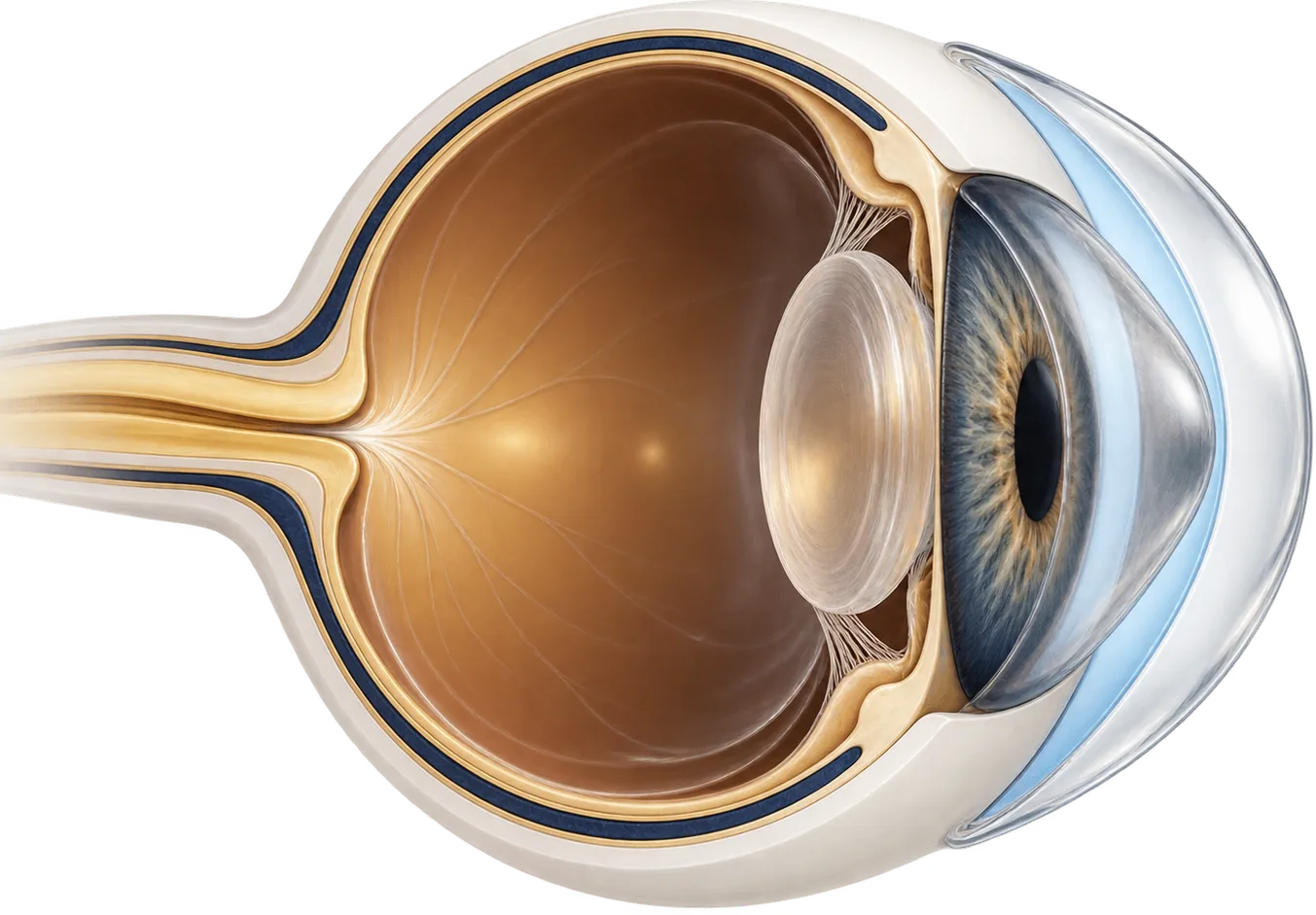
How severe dry eye affects the eye and vision
Dry eye is more than a shortage of tears. The Tear Film and Ocular Surface Society’s 2017 DEWS II report defines it as a multifactorial disease in which the tear film loses its balance. An unstable, overly salty tear film, inflammation, surface damage, and nerve changes all play a part.[1]
There are two broad types. In aqueous-deficient dry eye the tear glands don’t make enough watery tears. In evaporative dry eye the tears evaporate too quickly, often because the oil glands in the lids aren’t working well. DEWS II treats the two as a continuum, and many people have elements of both.[1]
Mild dry eye causes grittiness and discomfort. In severe dry eye the front of the cornea can become damaged. People describe burning, pain, light sensitivity, and vision that blurs and clears with each blink. Damage to the corneal surface can reduce vision in its own right.
How common it is depends on how it’s measured. Across the studies reviewed for DEWS II, dry eye prevalence ranged from 5% to 50%.[3] In the US, a 2013 national survey of 75,000 adults projected that 6.8% had been diagnosed with dry eye, about 16.4 million people.[4] It becomes more common with age: 2.7% of adults aged 18 to 34 had a diagnosis, compared with 18.6% of those 75 and older. Women were affected more often than men, 8.8% against 4.5%.[4] Estimates vary widely because studies define dry eye differently. Only a minority of people with dry eye have disease severe enough to need scleral lenses, and there is no reliable figure for how many.
How a scleral lens works for severe dry eye
A scleral lens is a large rigid gas-permeable lens. It rests on the sclera (the white of the eye) and arches over the entire cornea without touching it. Before insertion the lens is filled with sterile, preservative-free saline, which stays trapped between the lens and the cornea while the lens is worn.
For dry eye, that reservoir is the point. The lens does two things:
- It keeps the cornea bathed. A damaged cornea sits under a layer of fluid for as long as the lens is in, instead of drying out between blinks and drops.
- It shields the cornea from the eyelid. In severe dry eye, each blink drags the lid across a dry, damaged surface. With a scleral lens in, the lid slides over the smooth lens instead.
Because the fluid layer also smooths out an irregular corneal surface, many people see more clearly with the lens in.
Scleral lenses are not a first-line treatment. The DEWS II report sets out a four-step plan. Step 1 is education, changes to the home and work environment, lubricating drops, and lid hygiene. Step 2 adds measures such as preservative-free drops, punctal plugs, in-office gland treatments, and prescription medicines. Rigid scleral lenses appear at step 3, alongside serum eye drops and soft bandage lenses, for people whose dry eye isn’t controlled by the earlier steps.[2] Practitioners follow a similar order. In a survey of 778 scleral lens fitters, 63% said lubricant drops were the first thing they’d try for ocular surface disease, and 45% ranked scleral lenses sixth, seventh, or eighth.[5]
What the research shows
Most of the evidence comes from case series at specialist centers, not randomized trials. The studies below include people with dry eye from several causes, and often other surface diseases too.
Most people who complete a fit meet their treatment goals. At the Mayo Clinic, 212 patients were evaluated for scleral lenses for ocular surface disease. Of those, 115 completed the fitting process, and all but 2 achieved their therapeutic goals of better comfort, surface protection, or healing. Average vision improved from about 20/42 to 20/26. These patients had tried an average of 3.2 other treatments first.[6]
Surface health and symptoms can improve. In a Brazilian study of 41 eyes with moderate to severe dry eye, scleral lens wear improved vision, reduced tear saltiness and surface staining at 12 months, and improved dry eye symptoms and quality-of-life scores.[7]
Many wearers report a better quality of life. In a Boston series of 49 patients with severe surface disease, 92% reported that their quality of life improved, mainly through less light sensitivity and discomfort. Average wear time was 13.7 hours a day.[8]
People keep wearing them, though less often than people fitted for corneal shape. In a five-year follow-up of 121 patients, 64% of those treated for ocular surface disease were still wearing their device, compared with 84% of those treated for a distorted cornea.[9]
Other options, compared
Severe dry eye is usually managed with several treatments at once. Scleral lenses add to that plan rather than replacing it. For a detailed guide to dry eye treatment in general, our sister site 1-800-dry-eyes.com covers it in depth.
| Option | What it does | Typically suited to |
|---|---|---|
| Lubricating drops, gels, and ointments | Supplement the tear film | All stages; the usual starting point |
| Lid hygiene, warm compresses, in-office gland treatments | Improve the oil layer of the tears | Evaporative dry eye and meibomian gland dysfunction |
| Punctal plugs | Keep tears on the eye longer by blocking drainage | Aqueous-deficient dry eye not controlled by drops |
| Prescription anti-inflammatory drops | Reduce surface inflammation | Moderate disease with inflammation |
| Autologous serum drops | Drops made from the patient’s own blood | Severe disease not controlled by earlier steps |
| Soft bandage lenses | Cover and protect the cornea | Short-term protection; surface defects |
| Scleral lenses | Hold saline over the cornea and shield it from the lid | Severe disease not controlled by earlier steps |
| Amniotic membrane, surgical punctal closure, tarsorrhaphy | Protect or heal the surface surgically | The most severe cases, when other options are inadequate |
Questions to ask a scleral lens fitter
- How many patients with severe dry eye or ocular surface disease do you fit?
- Will you work with my eye doctor on my other dry eye treatments?
- Which of my current drops should I keep using, and when?
- How do you manage midday fogging if I get it?
- How many visits does a fit usually take, and what do the fees cover?
- Do you bill my insurance directly, or give me a superbill to submit myself?
- Who do I call if the lens becomes painful or I can’t get it out?
Common questions
Should I try scleral lenses before other dry eye treatments?
Generally not. International dry eye guidelines place scleral lenses at the third of four steps, after measures like lubricating drops, lid care, punctal plugs, and prescription medicines have been tried. Your eye doctor can tell you whether your dry eye is severe enough to consider them.
Do scleral lenses cure dry eye?
No. They protect the surface of the eye and keep it moist while you wear them. The underlying cause of the dry eye is still there, so most people keep using other treatments alongside the lenses.
Can I still use eye drops with scleral lenses?
Often, yes, but it depends on the drop and on your fitter's advice. Some drops are used before the lens goes in or after it comes out rather than on top of it. Ask your fitter and your eye doctor which of your drops to keep using and when.
How long can I wear scleral lenses each day for dry eye?
Many people wear them for most of their waking day, but wear time varies from person to person. Scleral lenses are removed before sleep unless your doctor tells you otherwise. Your fitter will set a schedule and build it up over time.
Why do my scleral lenses get cloudy during the day?
Debris from the tear film can build up in the saline under the lens, which makes vision hazy. This is common in people with surface disease. Removing, rinsing, and refilling the lens usually clears it, and your fitter may be able to adjust the fit to reduce it.
Will I feel relief as soon as the lens goes in?
Many people with dry eye feel relief quickly, because the cornea is suddenly covered with fluid. Full comfort usually takes longer, since the fit, the fill, and your drops often need adjusting over several visits. A short trial can mislead either way, so judge the lenses over time with your fitter.
Why do the corners or the white of my eye still burn with the lens in?
A scleral lens covers the cornea and part of the white of the eye, but your eyelids and the outer white are still exposed. Many wearers with dry eye still feel burning there, especially in wind or dry air. Tell your fitter where you feel it, because lid treatment, moisture chamber glasses, or a change in lens size can sometimes help.
Can my eyes be too dry for scleral lenses?
Rarely in the sense of being ruled out. People who make very few tears wear scleral lenses every day, but very dry eyes can make the lens surface smear and fog. Many need extra treatment alongside the lens, and some don't get on with lenses at all, so your fitter will judge it for your eyes.
Do I still need to treat my eyelids and oil glands?
Usually, yes. A scleral lens keeps the cornea moist, but it doesn't treat the eyelids or their oil glands, which can still cause smeary vision and lid discomfort. Most wearers who do well keep up the lid care and other treatments their eye doctor recommends.
Can I use punctal plugs and scleral lenses together?
Many people do. Plugs keep your own tears on the eye longer, while the lens holds saline over the cornea whatever your tear volume. Your eye doctor can tell you whether plugs make sense for you, and your fitter should know if you have them or are getting them.
Will scleral lenses damage my oil glands or reduce my own tear production?
Nobody knows for sure yet, and the studies so far are small and can't show cause and effect. One small study of scleral lenses for dry eye found no significant change in tear production or gland function. Ask your eye doctor to check your glands and tears at your regular visits.
Why do my eyes feel worse when I take the lenses out?
While the lens is in, your cornea sits in fluid, so the dry eye you still have can feel worse by contrast when the lens comes out. Wearers often use lubricating drops or gel after removal and keep up their other dry eye treatment. Redness, pain, or blur that lasts long after removal or keeps getting worse needs a call to your fitter or eye doctor.