
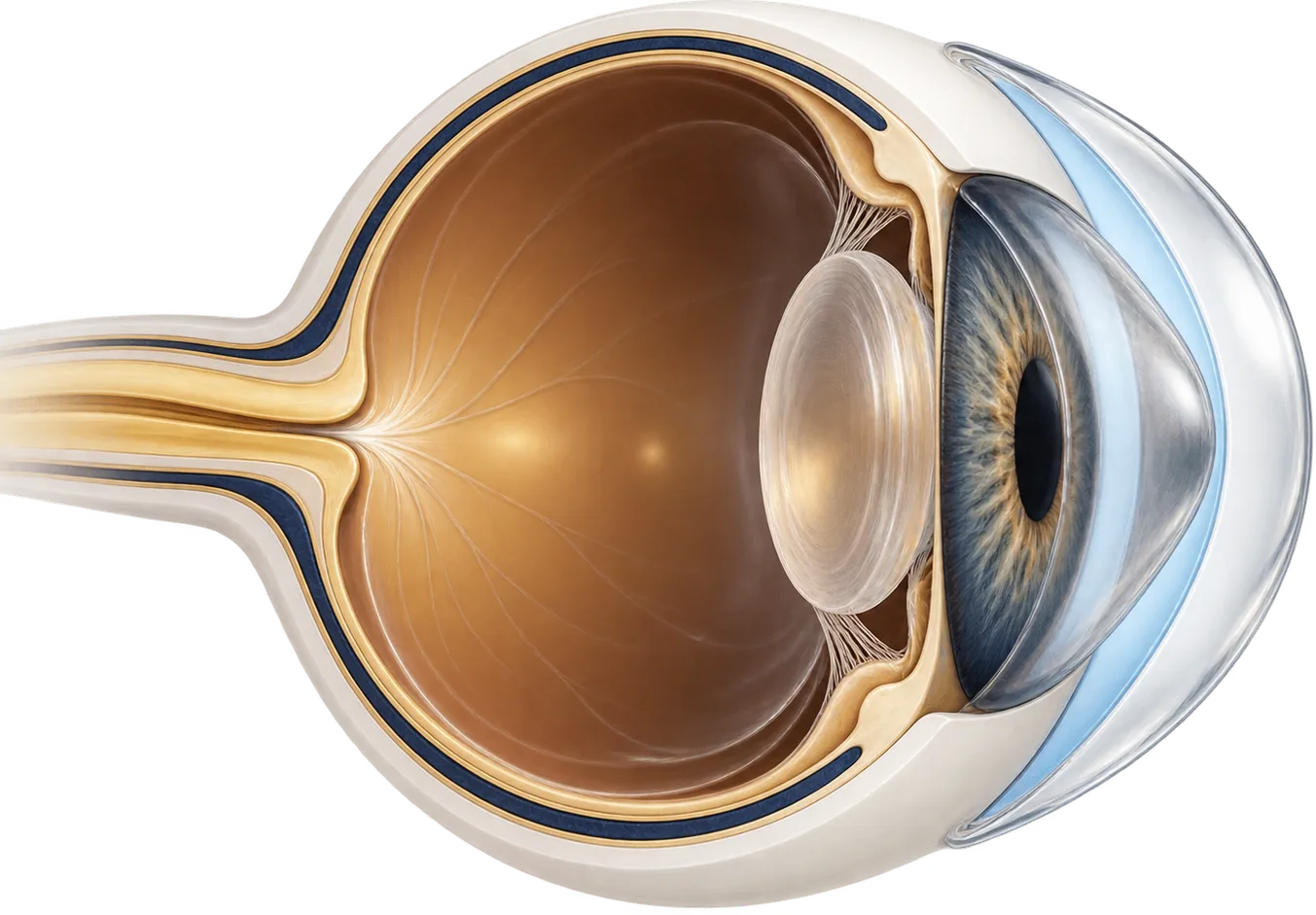
How ocular GVHD affects the eye and vision
Graft-versus-host disease (GVHD) can follow an allogeneic stem-cell or bone-marrow transplant, where the new blood-forming cells come from a donor. The donor’s immune cells can attack the recipient’s own tissues. Chronic GVHD is a slower, longer-lasting form. One major review reports that it affects up to 70% of transplant patients.[1]
The eyes are one of the organs most often involved. In a multicenter study of 284 people with chronic GVHD, 41% already had eye involvement within three months of their chronic GVHD diagnosis, and 57% had it within two years.[2] In a Dutch study that followed 101 transplant patients, ocular GVHD developed over time in 54%.[3]
The main problem is severe dry eye. The immune attack damages the tear glands, the oil glands along the eyelid margins, and the conjunctiva (the thin membrane over the white of the eye). Keratoconjunctivitis sicca, the medical term for this dryness, occurs in 40% to 90% of patients with ocular chronic GVHD.[7] People describe gritty, burning, painful eyes, sensitivity to light, and blurry vision that comes and goes with blinking. In more severe cases the conjunctiva scars and the cornea (the clear front window of the eye) breaks down.
Eye symptoms can start well after the transplant. In a review of 200 patients, the median time to onset of chronic ocular GVHD was 293 days after transplant. Eye involvement followed GVHD elsewhere in the body in 76% of patients, but came first in 7%.[4] That is one reason many experts encourage eye exams after transplant even when the rest of the body is doing well.
How it’s diagnosed. The NIH consensus criteria for chronic GVHD list new dry, gritty, or painful eyes, scarring of the conjunctiva, keratoconjunctivitis sicca, and patches of damage on the corneal surface as distinctive eye signs. A Schirmer tear test of 5 mm or less at 5 minutes, or new dry-eye damage seen on a slit-lamp exam with a Schirmer value of 6 to 10 mm, is enough to diagnose ocular chronic GVHD for treatment, provided nothing else explains it.[5] A separate international group of eye specialists proposed a scoring system built on four measures: a symptom questionnaire, the Schirmer test, corneal staining, and redness of the conjunctiva. It sorts patients into no, probable, or definite ocular GVHD.[6]
How a scleral lens works for ocular GVHD
A scleral lens is a large rigid gas-permeable lens. It rests on the sclera (the white of the eye) and arches over the whole cornea without touching it. Before insertion the lens is filled with sterile, preservative-free saline, so a pool of fluid sits against the cornea for as long as the lens is in.
That arrangement helps a GVHD eye in two ways:
- It keeps the cornea bathed. When the eye can’t make enough tears, the saline reservoir does the job of a tear film. The cornea stays wet between blinks and throughout the day, not just for the minutes after an eye drop.
- It shields the cornea from the eyelids. Inflamed lid margins and a dry surface make every blink rub. With a scleral lens in place, the lids glide over the smooth lens instead of the damaged cornea. That can let surface damage heal.
The fluid layer also smooths out an irregular corneal surface optically, which is why vision often sharpens as well as comfort improving.
PROSE (prosthetic replacement of the ocular surface ecosystem) is a scleral-device treatment developed by the Boston Foundation for Sight. Much of the early research in ocular GVHD used PROSE devices. More recent studies use other custom and mini-scleral lens designs.
Working with your transplant team. Ocular GVHD is one part of a disease that can affect the skin, mouth, lungs, and other organs. Many patients take medicines that suppress the immune system. A scleral lens fitter should be in contact with the eye doctor managing the GVHD and aware of the transplant team’s plan, so that lens wear, eye drops, and any changes in systemic treatment fit together.
What the research shows
Vision and comfort improve for most people who are fitted. In a study of 79 eyes with ocular chronic GVHD, 71 eyes (90%) saw better with PROSE. On average, vision improved from about 20/60 to about 20/30. Corneal staining, a sign of surface damage, decreased in 84% of eyes. Among patients with follow-up questionnaires, the Ocular Surface Disease Index (a symptom score, where higher is worse) fell from 72.6 to 21.1.[8]
Newer mini-scleral lenses show similar results. A 2024 study of 62 eyes found median vision of 20/25 with mini-scleral lenses, compared with 20/40 in glasses. The median symptom score fell from 73 to 27, and corneal staining improved.[9]
The benefit shows up in everyday function. A review of PROSE treatment records found 407 patients with ocular chronic GVHD treated between 2002 and 2011. Among patients treated at network clinics in 2010, scores on a standard visual-function questionnaire rose by 41 points six months after treatment.[7] An earlier series fitted all 10 eyes of 5 patients with severe dry eye from GVHD. All 5 reported better comfort, and vision improved in 7 of the 10 eyes.[10]
Patients report broad relief, and many find out late. In a survey of 306 people with ocular GVHD, scleral lens wearers most often reported less dryness and grittiness (94%) and less eye pain (92%). Of the wearers, 56% wished the lenses had been recommended sooner. Among those not wearing scleral lenses, the most common reason was that they had never heard of them (63%).[11]
Other options, compared
Scleral lenses usually sit alongside other treatments rather than replacing them. Your eye doctor and transplant team decide the mix.
| Option | What it does | Typically suited to |
|---|---|---|
| Preservative-free artificial tears, gels, and ointments | Add moisture to the eye surface | Everyone with ocular GVHD, as a base layer |
| Warm compresses and lid care | Help the oil glands along the lid margins | Lid-margin inflammation and blocked glands |
| Punctal plugs or punctal closure | Keep the eye’s own tears on the surface longer | Moderate to severe dryness |
| Prescription anti-inflammatory drops | Calm inflammation on the eye surface | Active inflammation; chosen and monitored by an eye doctor |
| Autologous serum or other blood-derived drops | Drops made from the patient’s own blood | Severe dryness or surface damage not controlled by other drops |
| Bandage soft contact lenses | Cover the cornea to help it heal | Short-term use for surface breakdown |
| Scleral lenses | Hold a saline reservoir over the cornea and shield it from the lids | Moderate to severe cases when drops and plugs aren’t enough |
| Surgery to the lids or ocular surface | Repair scarring, protect the cornea, or partly close the lids | Severe scarring or corneal breakdown |
Questions to ask a scleral lens fitter
- How many patients with ocular GVHD do you fit each year?
- Will you share your notes with my eye doctor and my transplant team?
- Which lens design do you use, and how many visits does a fit usually take?
- What cleaning routine do you recommend while I’m on immune-suppressing medicine?
- Can a family member or caregiver learn to put the lenses in and take them out?
- What should I do if a lens fogs, or if my eye becomes red or painful while wearing it?
- Do you bill my insurance directly, or give me a superbill to submit myself?
Common questions
Can scleral lenses cure ocular GVHD?
No. GVHD is an immune reaction, and a lens doesn't change it. A scleral lens protects the eye surface and keeps it wet, which can ease pain and improve vision. Treatment of the GVHD itself stays with your transplant team and eye doctor.
When should I think about scleral lenses?
They are usually considered when drops, ointments, plugs, and prescription anti-inflammatory drops aren't enough. In a survey of people with ocular GVHD, 56% of scleral lens wearers wished the lenses had been recommended sooner. Ask your eye doctor whether you are a candidate.
Is it safe to wear scleral lenses while on immune-suppressing medicine?
Many people with GVHD do wear them, but it needs care. Your fitter and your transplant team should both know about the lenses, and you should follow cleaning and follow-up instructions closely. Remove the lens and call your eye doctor the same day if your eye becomes red, painful, or your vision drops.
What if I'm too unwell or weak to handle the lenses?
Handling is a real barrier. Some people have a family member or caregiver learn to insert and remove the lenses. In one study, 22.6% of patients stopped wearing mini-scleral lenses, so it is worth talking through practical help before starting.
Are scleral lenses covered by insurance for GVHD?
Sometimes. Some medical plans cover scleral lenses when they are medically necessary for a disease of the eye surface. Coverage depends on your plan and on whether the practice is in network, so ask for the codes and a written estimate.
Will I still need serum tears or my other eye drops?
Often, yes, though many wearers say they need them less once the lenses are in. Drops and gels are still commonly used when the lenses are out, especially at night. Don't stop or cut back any prescribed eye medicine without your eye doctor's advice.
My eyes still flare up even though the lenses fit well. Is that expected?
Ocular GVHD can flare with illness, allergies, and other triggers, with or without lenses. Tell your eye doctor and fitter about flares, since your treatment or lens routine may need adjusting. If your eye becomes red and painful or your vision drops, remove the lens and call your eye doctor today.
My new lenses aren't as comfortable or clear as I hoped. What should I do?
Go back to your fitter, because the first lens is rarely the final one. Fits are often refined over several visits, and early discomfort sometimes improves as the eye surface settles. Write down what bothers you and when, so your fitter can target the problem.
Can I have cataract surgery if I wear scleral lenses for GVHD?
Yes, wearers with ocular GVHD have had cataract surgery. Your surgeon, fitter, and transplant team should plan it together, including how your dry eye is managed around the operation. Expect a new lens prescription and possibly a refit once the eye has healed.