
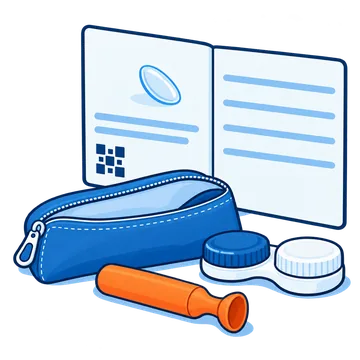
What it is
New scleral lens wearers leave the dispensing visit with a lot to remember, and handling is where many of them struggle. In a year-long study of 95 wearers, handling was the most common reason people stopped, while the number of attempts needed to insert and remove lenses dropped significantly over the year for those who kept going.[7] The handout is a take-home reminder for those first weeks. It supports your training; it doesn’t replace it.
What’s on it
Page 1
- From your eye doctor: blank lines for the fitter or practice, phone and after-hours numbers, the fill solution, the cleaning system, any approved artificial tears, a week-by-week wearing schedule, the follow-up date, and other instructions.
- Putting a lens in: the inserter method in eight short steps, then the three checks after every insertion (light, vision, comfort).
- Taking a lens out: the removal plunger on the lower third of the lens, never the center, and what to do if it won’t release.
Page 2
- The morning and night routine, a short “never” list, and the case-replacement interval.
- The first month: practicing before leaving the office, following the wearing schedule exactly, bringing notes to the follow-up, and judging progress after two to three weeks rather than days.
- Three tiers of symptoms: common while learning, worth a call or a mention at the follow-up, and remove the lens and call today.
- A supplies checklist and a QR code to our free course for new wearers.
Where the content comes from
The handout repeats claims from our sourced patient guides, in the same words where possible: how to insert, how to remove, the daily routine, the first two weeks, discomfort and lens awareness and eye pain: when to get help. The care rules follow these sources:
- Preservative-free saline in the bowl. Preservatives such as benzalkonium chloride can damage corneal and conjunctival surface cells.[5]
- No water on lenses or cases. The FDA advises against exposing lenses to tap, bottled or distilled water, which have been linked to Acanthamoeba keratitis.[1] Cases have been reported in scleral lens wearers, with care habits such as overnight storage in saline and not rubbing the lens among the risks the authors described, and a warning against topping off case solution.[6]
- Rub, rinse, fresh solution, no topping off, case air-dried and replaced every three months or as directed.[2]
- Hydrogen peroxide: full neutralization before insertion, the new case from each bottle, and never rinsing with peroxide.[3]
- No sleeping in lenses, makeup after insertion and off after removal, and a backup pair of glasses.[4]
- The warning signs, and what to do with the lens: remove it, don’t reinsert it, call the eye care professional, and keep the lens in its case to bring along.[1]
The handout gives no wearing times, replacement schedules for lenses or plungers, or product names. Those are left for you to write in.
Free, unbranded, and no affiliation implied
There’s nothing to sign up for and nothing to pay. The only name on the handout is our web address, so it doesn’t advertise any practice, product or lens brand. Its footer tells patients it comes from an independent information site, isn’t affiliated with the practice that gave it to them, and doesn’t replace their eye doctor’s instructions.
About this site explains who writes it and how it’s sourced.
How to print it
- Open the handout page and choose Print the handout, or use your browser’s print command.
- Choose US Letter or A4 and print at “actual size”, not “fit to page”. Each page fits either paper size.
- Print double-sided (flip on the long edge) or on two sheets. Black and white works; color only shades the boxes.
- To save handwriting, type your practice details, solutions or standard schedule into the box before printing. What you type is saved only in that browser on that computer, so it’s there next time; the Clear typed fields button removes it. Nothing is sent to us.
Want a PDF to keep on file? Choose “Save as PDF” as the printer.
Prefer a ready-made file? The fillable PDF version has the same content with a typeable box for your details. Practices that don’t have a superbill form can also use our fillable superbill template; you enter every code and fee. See all fillable forms.
Common questions
Is the handout really free?
Yes. There's no sign-up, no fee and no limit on copies. Print as many as you need, for as long as you like.
Can I add my practice's name or logo?
The top box has a line for the fitter or practice and phone numbers, which you can write in, stamp, or type before printing. The handout itself carries no branding except our web address.
What if my care protocol is different?
Write your instructions in the box, and cross out anything that doesn't apply. The handout tells patients that their eye doctor's instructions come first. If something on it conflicts with common practice, tell us through the contact page.
Does handing this out mean we're affiliated with the site?
No. The handout says it comes from an independent information site that isn't affiliated with the practice that gave it out. Giving it to patients implies no endorsement either way.
Can patients print it themselves?
Yes. The same page works for wearers, and the box can be filled in from their own fitter's instructions.