
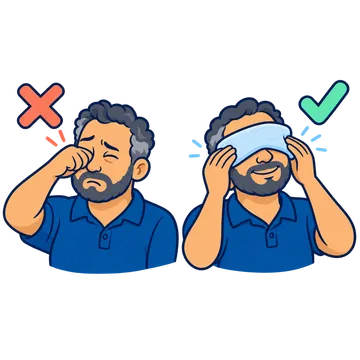
Cause, effect, or both?
Rubbing is one of the most studied risk factors in keratoconus, and the studies keep pointing the same way. Three reviews that pooled many studies each found that people who rub their eyes have higher odds of keratoconus. Depending on the review, the odds were roughly three to six times higher (odds ratios of 3.09, 3.64 and 6.46).[2][3][1] A fourth review, which looked at allergy as well, also found a clear link with rubbing.[4]
What those reviews can’t tell you is which came first. The review of six case-control studies noted that the studies were few, varied a lot, and were of moderate quality, and that “the cause-effect temporal relationship cannot be determined”.[1] In other words, rubbing might help cause keratoconus, early keratoconus might make eyes feel itchy or uncomfortable enough to rub, or both.
The most widely held model today is a combination. A cornea that is genetically prone to keratoconus gets a “second hit” from rubbing, or from pressing on the eye during sleep.[5] Some researchers go further and argue that mechanical trauma is necessary for keratoconus to start at all. The same review notes there are arguments for and against that idea, and that what we call keratoconus may turn out to be several look-alike conditions with different causes.[5]
So this isn’t about blame. Genes play a real part (see is keratoconus genetic?), and most people who rub do it because their eyes itch.
What about contact lenses?
People sometimes ask whether wearing contact lenses, rather than rubbing, can cause keratoconus. A 1990 review of 199 patients’ records found 53 whose keratoconus was diagnosed after an average of 12.2 years of contact lens wear, with no keratoconus found at the original fitting, and the authors suggested long-term lens wear could be a factor.[14] But “no keratoconus” then meant a normal slit lamp exam, curvature readings and glasses test. Modern corneal tomography detects much earlier disease, before vision is affected,[15] so some of those eyes may already have had it. Once keratoconus is present, a Japanese study found rigid lens wear over five to six years didn’t affect progression.[16] The myths page covers whether lenses make keratoconus worse.
How rubbing might affect the cornea
A review of the possible mechanisms lists several ways rubbing could stress a cornea: thinning of its surface layer, inflammatory chemicals in the tears, large spikes in eye pressure, a rise in corneal temperature, and collagen fibers slipping against each other at the tip of the cone.[6] The author describes these as known and proposed mechanisms. They haven’t been proven to cause keratoconus in people.
Does how you rub matter?
One clinic in Paris compared 202 people with keratoconus with 355 people without it. Rubbing with the knuckles had the strongest link (odds ratio 8.29), and rubbing with the fingertips was also linked (odds ratio 5.34).[7] It was a single-center study, so the exact numbers may not hold elsewhere.
We couldn’t find a study of gentle touching of the eyelids or the corner of the eye. That means there’s no evidence it’s safe, and none that it’s harmful.
Night rubbing and sleeping position
A small study of 33 people with keratoconus that was one-sided or much worse in one eye, compared with 64 people without it, found strong links with sleeping on the stomach or side, and with sleeping on the side of the worse eye.[8] The Paris case-control study also found links with stomach and side sleeping.[7] But when a later review pooled the studies of sleeping position, the results were not statistically significant and the uncertainty was very wide.[3]
So the honest answer is that sleeping position might matter, and the evidence isn’t settled. If you wake up rubbing, or always sleep with one eye pressed into the pillow, tell your eye doctor.
Does stopping help?
There’s some encouraging evidence. A French clinic told 77 people with keratoconus to stop rubbing and followed 153 eyes for an average of 53 months. On average, the corneas didn’t change significantly. Of the 26 eyes that did show signs of progression, 25 belonged to people who said they were still rubbing or doing other at-risk things.[9]
It was one clinic with no comparison group, so it can’t prove that stopping prevents progression. It is linked with stability, though, and that is a good reason to try. Stopping doesn’t replace your follow-up scans or cross-linking if your specialist recommends it. See will my keratoconus keep getting worse? and scleral lenses after cross-linking. If you’ve only just been diagnosed, just diagnosed with keratoconus? covers the rest of the usual path.
Allergy, itch and rubbing
Allergy and keratoconus are linked, but less clearly than rubbing. One large review found higher odds of keratoconus with allergy (odds ratio 1.42), asthma (1.94) and eczema (2.95).[2] A later review confirmed the link with allergy (odds ratio 2.21) but found no significant link with allergic eye disease, atopy or asthma.[4]
The practical point is simpler: itch drives rubbing. For the studies on each condition, see is keratoconus linked to eczema, asthma or allergies? If your eyes itch often, ask your eye doctor whether allergy or dry eye is behind it (see does keratoconus cause dry eye?), and which drops you can use around your lenses. Don’t put allergy drops in the lens bowl unless you’re told to. See scleral lenses and eye allergies and eye drops with scleral lenses. If your eyes itch mostly after you take your lenses out, mention it to your fitter: see am I allergic to my scleral lenses?
For families and caregivers: in a study of people with Down syndrome, eye rubbing was a significant risk factor for keratoconus.[10] Our guide to keratoconus and Down syndrome has practical ideas for carers.
Rubbing, hydrops and cross-linking
Corneal hydrops, a sudden swelling of the cornea in advanced keratoconus, is thought to be set off by minor injury to a thin cornea, “mostly by eye rubbing”.[11] In a US study of 762 people with unstable keratoconus, rubbing was more common in those who had hydrops (85.5% vs 67.7%), though it wasn’t an independent predictor once other factors were accounted for.[12]
After cross-linking, the Photrexa label says patients should be advised not to rub their eyes for the first five days.[13] The aftercare for each method is covered in epi-off cross-linking, step by step and epi-on cross-linking, step by step.
Ways to stop (practical tips, not tested in trials)
We couldn’t find any trial of habit-breaking methods for keratoconus, so treat these as practical ideas to discuss with your eye doctor:
- Swap the rub for cold. A cool compress, or chilled preservative-free artificial tears, can take the edge off an itch.
- Treat the cause. Ask about allergy, dry eye or eyelid problems that keep your eyes itchy.
- Notice your triggers. Many people rub on waking, when tired, or after taking lenses out. Knowing when you do it makes it easier to catch.
- Ask about nighttime protection. If you rub in your sleep, ask your doctor whether something to cover your eyes at night is a good idea for you.
Common questions
Can contact lenses cause keratoconus?
It hasn't been shown. A 1990 review of patient records described keratoconus being diagnosed in some people after many years of contact lens wear, and its authors suspected the lenses played a part. But the checks used back then could miss early keratoconus that today's corneal scans pick up, and the study couldn't prove cause. In a later study of people who already had keratoconus, rigid lens wear over five to six years didn't affect progression. If you need lenses to see, this isn't a reason to stop. Have them fitted and checked by someone experienced, and avoid rubbing your eyes when you take them out.
Did I cause my keratoconus by rubbing my eyes?
Researchers don't know, and it's very unlikely to be that simple. Genes play a part too, and the main explanation is that rubbing adds a mechanical "second hit" to a cornea that was already prone to keratoconus. Many people rub because their eyes itch from allergy or dryness, which is a reflex, not a choice. What matters now is what you do from here.
Is rubbing the corners of my eyes or my eyelids gently OK?
We couldn't find any study that has tested gentle touching of the lids or the inner corner, so we can't tell you it's safe or harmful. Ask your eye doctor what they'd like you to do instead when your eyes itch.
I already have keratoconus. Is there any point in stopping now?
Yes. In a French clinic's long-term follow-up of people told to stop rubbing after their diagnosis, most corneas stayed stable on average, and almost all the eyes that did progress belonged to people who kept rubbing. It was one clinic without a comparison group, but it fits what cornea specialists advise. Keep your follow-up scans too: stopping rubbing doesn't replace monitoring or cross-linking.
Can I rub my eyes after cross-linking?
No. The FDA label for the Photrexa cross-linking system says patients should be advised not to rub their eyes for the first five days after the procedure. Follow your own surgeon's instructions, which may be stricter.
I just rubbed my eye without thinking. Did I undo everything?
Almost certainly not. The studies linking rubbing to keratoconus looked at rubbing as a habit, repeated over months and years, not at a single rub. Don't rub again to check how it feels: if your eye itches, use a cool compress or artificial tears your eye doctor approves, and if you were wearing a lens, make sure it's still centered and comfortable. If you recently had cross-linking or surgery, or you notice pain or a sudden drop in vision, call your eye doctor today.