
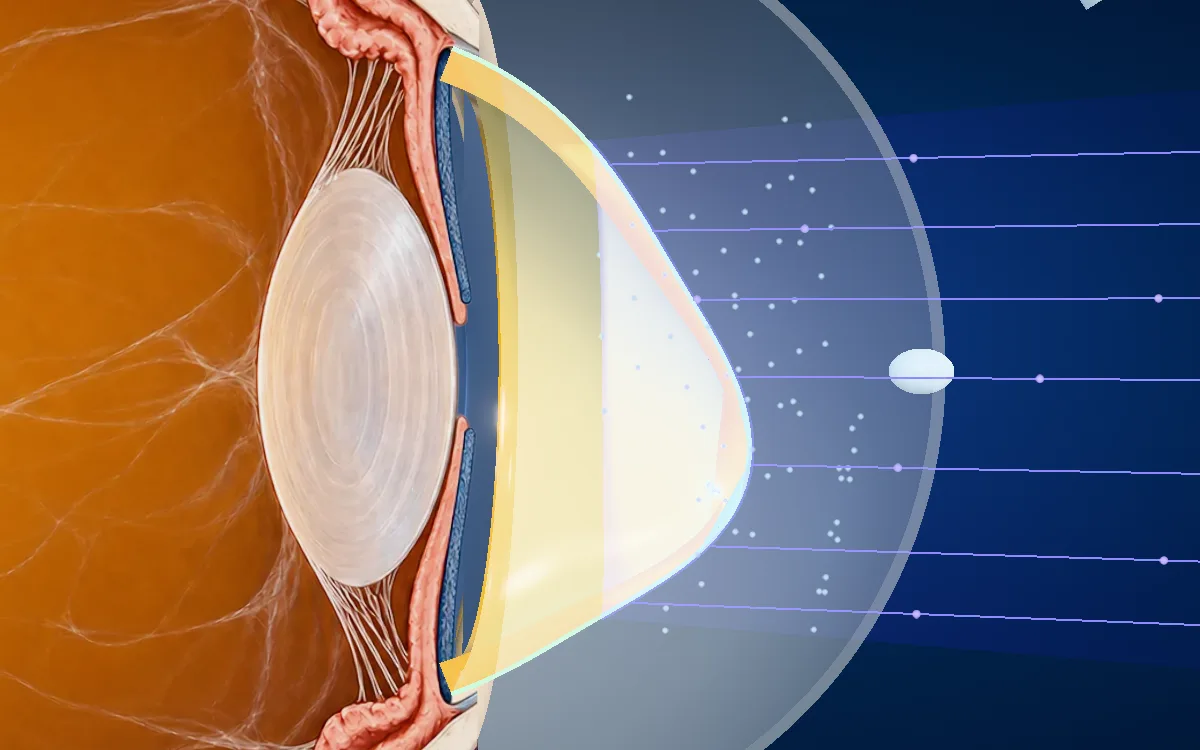
What epithelium-on cross-linking is
Corneal cross-linking treats keratoconus, where the cornea (the clear front window of the eye) weakens and bulges into a cone. Riboflavin (vitamin B2) drops soak into the cornea, and ultraviolet light makes the riboflavin create reactive oxygen, which forms new bonds in the cornea’s collagen.[1] The aim is a stiffer cornea that stops getting steeper.
“Epithelium-on” means the thin surface layer of the cornea, the epithelium, stays in place. The US approved an epi-on system on October 17, 2025: Epioxa HD and Epioxa riboflavin drops, used with the O2n light system and oxygen goggles.[2] The steps on this page come from its US label and from the published methods of one of the two trials behind it.[1][3]
“Epi-on” has been used for several different protocols, in the US before this approval and elsewhere. Results and steps from one don’t automatically apply to another, so ask your surgeon which protocol they use. For the original method, which removes the surface layer first, see epi-off cross-linking, step by step.
Who it’s for, and who can’t have it
The label covers keratoconus in adults and children aged 13 and older.[1] It says “keratoconus”, where the older epi-off label says “progressive keratoconus”; whether yours is progressing, and whether treatment makes sense, is a question for your surgeon and your scans. See how to read your keratoconus scan. The approval doesn’t cover ectasia after laser eye surgery.
The label says cross-linking should not be performed on pregnant women, and warns that it can reactivate herpes infection in the eye, so tell your surgeon if you’ve ever had it.[1]
Corneal thickness. Thickness is measured in microns, thousandths of a millimeter. The epi-on label says the light should not be used if the cornea is thinner than 325 microns. Unlike the epi-off label, it has no step for swelling a thin cornea to reach the limit.[1] The trial also left out eyes under 325 microns at their thinnest point on a screening scan.[3] The epi-off method has a higher limit, 400 microns, under a different protocol.[4] These are label thresholds, not evidence that one method suits thin corneas better, so ask your surgeon what your thinnest reading means for you. If you’ve been told you’re too thin for one method, a second opinion on cross-linking can help.
Before the day
- Scans. Your surgeon will want recent scans, and many plans ask for specific findings (see the insurance section below).
- Your lenses. We could not find a source that sets how long to leave contact lenses out before cross-linking. Your surgeon will tell you when to stop wearing yours and when to come in without them.
- A pain plan. Ask what to take for pain and what to do if it isn’t enough.
- Getting home. Ask the clinic whether you need someone to take you home, and plan a few quiet days.
- Your history. Tell your surgeon if you’re pregnant or have had herpes in the eye.
On the day, step by step
These are the seven steps in the animation above, with the detail the label and the trial give.
1. Awake and numbed
Numbing eye drops go in, and a lid speculum, a small clip, holds your eyelids open.[1] You’re awake. The label doesn’t say whether you sit or lie down for this system.
2. The surface layer stays
The surgeon soaks a small cellulose sponge in the first riboflavin drop and swipes it across the cornea 4 to 10 times, horizontally and vertically. This removes the thin mucus layer on top without removing the epithelium.[1] The trial report calls these “gentle swipes”.[3]
3. Riboflavin soaks in
The drops go on in two steps:[1]
- Step 1, 4 minutes: two drops of the first riboflavin solution (Epioxa HD) every 60 seconds.
- Step 2, 6 minutes: two drops of the second solution (Epioxa) every 30 seconds.
The first is a clear yellow solution whose ingredients include benzalkonium chloride and hydroxypropyl methylcellulose; the second contains neither.[1] The trial authors describe these as helping the riboflavin pass through the intact surface layer into the tissue below.[3]
Then the surface is gently rinsed with about 5 mL of balanced salt solution, and a small ultrasound probe touches the numbed cornea to measure its thickness. Under 325 microns, the light isn’t used.[1]
4. Oxygen, then light
Goggles go over the eye and the oxygen flow is turned on.[1] In the trial, the oxygen was humidified, the goggles went on immediately after the thickness check, and oxygen at the eye’s surface stayed at about 90% or more. The eye was numbed again before the light.[3]
The light head is centered over the cornea, and the system automatically delivers ultraviolet A light at 365 nm and 30 mW/cm² for 11 minutes 6 seconds, switching 1 second on, 1 second off the whole time.[1] The trial describes the light as a uniform circle 9 mm across.[3] During the light, drops of balanced salt solution (not riboflavin) go on every 2 minutes, or more often, to keep the cornea from drying.[1]
You will probably see the light: in the trial, the sham (fake) treatment used a dimmer light chosen so that it could be seen, so participants couldn’t tell which group they were in.[3]
Why oxygen and pulsing? The trial authors explain that an intact surface layer slows oxygen getting into the cornea, that the reaction needs oxygen, and that a strong continuous light uses it up quickly, so they paired extra oxygen with pulsed light. Those are the explanations of the sponsor’s own researchers; the label states the steps without giving reasons.[3]
5. New bonds form
The label explains the chemistry: under these conditions riboflavin produces singlet oxygen, a reactive form of oxygen, which is responsible for the cross-linking.[1] The bonds form in the collagen fibers that make up the cornea. Studies of epi-off treatment show the bonds concentrate in the front part of the cornea; we found no published measurement of how deep they reach with this epi-on protocol.
6. Stiffer, not flatter
The goal is a cornea that stops getting steeper. Both trials compared epi-on cross-linking with a sham treatment. At 12 months, the steepest corneal reading (Kmax) was about 1 diopter flatter in treated eyes than in sham eyes in each trial (-1.1 and -1.0 diopters).[1] That is a small change compared with the shape of a typical cone. Cross-linking isn’t designed to sharpen your vision, so most people still need glasses, scleral lenses or other specialty lenses afterward.
Age mattered in the trials. In one, people under 29 showed a 2.0 diopter difference from sham at 6 months, partly because their untreated eyes got worse, while people 29 and older “did not experience improvement at month 6 in either arm”.[1] Ask your surgeon how your age affects the benefit you can expect.
7. A bandage lens
When the light stops, the oxygen is turned off and the goggles and lid speculum come off. A bandage contact lens goes on.[1] In the trial, the eye was checked at the slit lamp first, and people went home with anti-inflammatory (NSAID) eye drops and tablets, antibiotic drops and artificial tears.[3] How long the bandage lens stays isn’t set in the label or the trial report; your surgeon decides.
How long it takes
Adding up the label’s steps: 4 and then 6 minutes of drops, the rinse and thickness check, the goggles, then 11 minutes 6 seconds of light. So the drop-and-light steps take roughly half an hour.[1] Numbing, the sponge and the bandage lens come on top. Neither the label nor the trial gives a total time in the room, so ask your clinic how long to plan for.
The second eye. In both trials, the second eye was treated between 1 week and 3 months after the first.[1] Ask your surgeon what they plan for you.
Aftercare and recovery
What the label says. You may have discomfort in the treated eye, and sunglasses may help. Call your doctor straight away for severe pain or a sudden drop in vision.[1] The epi-on label doesn’t repeat the epi-off label’s instruction not to rub your eyes for five days,[4] but rubbing is bad for keratoconus in general: see eye rubbing and keratoconus, and ask your surgeon.
Drops. Use the drops your surgeon prescribes, exactly on their schedule.
Pain. A 2021 review found epi-on treatment causes less pain in the first days than epi-off, but the difference in pain scores and painkiller use disappears after the first few days.[7] So plan for some discomfort and a few quiet days, and use numbing drops only if prescribed and only as directed: what to expect from cross-linking explains why.
Going back to scleral lenses
The epi-on label gives no timeline for recovery or for going back to contact lenses, so your surgeon decides.[1] The studies of scleral lens wear after cross-linking so far come from epi-off treatment. In one, 61% of 18 eyes needed a change to the lens fit or power in the year after, though vision with the lens didn’t change.[8] Plan for a refit check either way.
Our page on scleral lenses after corneal cross-linking covers timing, refits and what the research shows, and cross-linking and scleral lens timing is written for the eye doctors involved.
What it can and can’t do
- It can slow or stop the cone getting worse. That is its job; the trials measured it against a sham treatment.[1]
- It barely flattens the cone. About 1 diopter more than sham at a year.[1]
- Whether it works as well as epi-off is unknown. A Cochrane review of older epi-on protocols found no clear difference at a year but rated the evidence very low certainty,[6] and no head-to-head trial of the two US-approved systems has been published that we could find.
- It isn’t for every cornea. No light under 325 microns, and it isn’t approved for ectasia after laser surgery.[1]
How epi-on compares with epi-off and accelerated cross-linking, and the other outcome figures, are charted in corneal cross-linking statistics.
Risks and side effects
In 389 treated eyes in the trials, redness of the white of the eye was the most common reaction, in 31%. Haze, light sensitivity, punctate keratitis (tiny spots of surface damage), eye pain, irritation, watering, a surface defect, eyelid swelling, corneal striae (fine lines), reduced vision, dry eye and inflammation inside the eye each occurred in 5% to 25%. The label also warns that cross-linking can reactivate herpes in the eye.[1]
In the published report of one trial, punctate keratitis was the most common adverse event, in 6.5% of treated eyes vs 1.8% with sham, and there were no serious eye side effects.[3] A Cochrane review found moderate-certainty evidence that epi-off causes slightly more haze or scarring than epi-on.[6]
The label warns that side-effect rates from different trials can’t be compared directly, so don’t read these numbers against the epi-off label’s as a contest.[1]
How epithelium-off differs
The epithelium-off method, approved in the US in 2016, removes the central surface layer first. It uses riboflavin drops every 2 minutes for 30 minutes, checks that the riboflavin has soaked all the way through, and then uses a weaker, continuous light for 30 minutes in ordinary room air. Its thickness limit is 400 microns, and its label doesn’t establish safety under age 14.[4] In January 2026, Photrexa’s maker, Glaukos, notified the FDA that it would stop manufacturing the Photrexa cross-linking kit as of July 2026, and the FDA lists it as discontinued.[5] Our epi-on vs epi-off comparison covers what the trials did and didn’t show about the two.
Insurance coverage
In the US, coverage for epi-on cross-linking is still settling: some plans list it with its own criteria, separate from epi-off, and others may not have updated their policies since the 2025 approval. Your plan’s written policy decides, and many plans need prior authorization first.
- Separate criteria. Aetna covers epi-on cross-linking with Epioxa for keratoconus in members 13 and older who meet a list of findings: topography consistent with keratoconus, a steepest reading (Kmax) of at least 47.00 diopters, central or lower steepening on a Pentacam map, and at least one other sign of keratoconus. It is not covered if the cornea is under 325 microns at its thinnest on Pentacam, if the eye has had earlier corneal surgery, Intacs or cross-linking, or in several other situations the policy lists.[9]
- Codes. Aetna lists CPT 0402T for the cross-linking and HCPCS J2789 for Epioxa.[9] Blue Cross NC’s policy notes the 2025 Epioxa approval.[10] Ask the clinic’s billing team which codes it will submit, and check each one with your plan.
- If you’re turned down. For most private plans you can file an internal appeal within 180 days of the denial, and the plan must decide within 30 days for care you haven’t had yet.[11] A policy that hasn’t caught up with epi-on is worth asking about: request the current policy and its review date.
The full guide, with the questions to ask your plan, is cross-linking and insurance. See also prior authorization and appealing a denied claim.
What people who’ve had it say
This is what members of patient communities mentioned about their own cross-linking, all methods combined. We don’t show figures for epithelium-on on its own yet. It isn’t advice and it isn’t a source: your surgeon’s instructions come first, and the sourced guidance is in the sections above.
Questions to ask your surgeon
- Do my scans show my keratoconus is changing? Which readings are you comparing?
- Which epi-on protocol do you use: the US-approved system or another?
- How thick is my cornea at its thinnest, and does that rule anything out?
- How does my age change the benefit I can expect?
- When should I stop wearing my lenses before the day?
- What should I take for pain, and what if it isn’t enough?
- Will you treat one eye or both, and how far apart?
- When can I go back into my lenses, and should I see my fitter first?
Common questions
Is epi-on cross-linking painless?
No. Because the surface layer isn't removed, it tends to hurt less in the first days than epi-off, but a review found the difference in pain and painkiller use disappears after the first few days. The label says there may be discomfort in the treated eye. Ask your surgeon for a pain plan before the day.
How long does epi-on cross-linking take?
The label's drop and light steps add up to roughly half an hour: 4 and then 6 minutes of riboflavin drops, a rinse, a thickness check, the goggles, then 11 minutes 6 seconds of pulsed light. Add time for numbing and the bandage lens. Neither the label nor the trials state a total time in the room, so ask your clinic how long to plan for.
Why are oxygen goggles used?
The trial authors explain that the intact surface layer slows oxygen getting into the cornea, and the cross-linking reaction needs oxygen. The goggles raise the oxygen at the eye's surface, and the light pulses on and off so the oxygen isn't used up. The label itself states the steps but doesn't give the reason.
Can teenagers have epi-on cross-linking?
The US epi-on system (Epioxa) is approved for adults and children aged 13 and older. Your child's surgeon will weigh age, scans and corneal thickness.
Does insurance cover epi-on cross-linking?
Some US plans now list it with its own criteria, and others may not have updated their policies yet. Aetna's published policy, for example, covers it for members 13 and older who meet a list of scan findings, and not if the cornea is under 325 microns at its thinnest. Ask your plan for its written criteria and ask the clinic which codes it will submit and whether it needs prior authorization.
When can I wear my scleral lenses again?
Your surgeon decides. The epi-on label gives no timeline for recovery or for going back to contact lenses, and studies of lens wear after cross-linking so far come from epi-off treatment. Plan for a refit check with your fitter.