
The one big difference
The epithelium is the thin surface layer of the cornea. The original cross-linking method removes it before the riboflavin drops and ultraviolet light; the newer method leaves it in place.
- Epi-off (epithelium-off): after numbing drops, the surgeon removes the surface layer over an area about 9 mm across, then applies riboflavin and ultraviolet light. In the US this is Photrexa with the KXL system.[1]
- Epi-on (epithelium-on, also called transepithelial): the surface layer stays. With the US-approved Epioxa system, only the mucus layer on top is wiped away “without debriding the corneal epithelium”, riboflavin is applied in two steps, and goggles deliver extra oxygen during the light treatment. A bandage contact lens goes on at the end.[3]
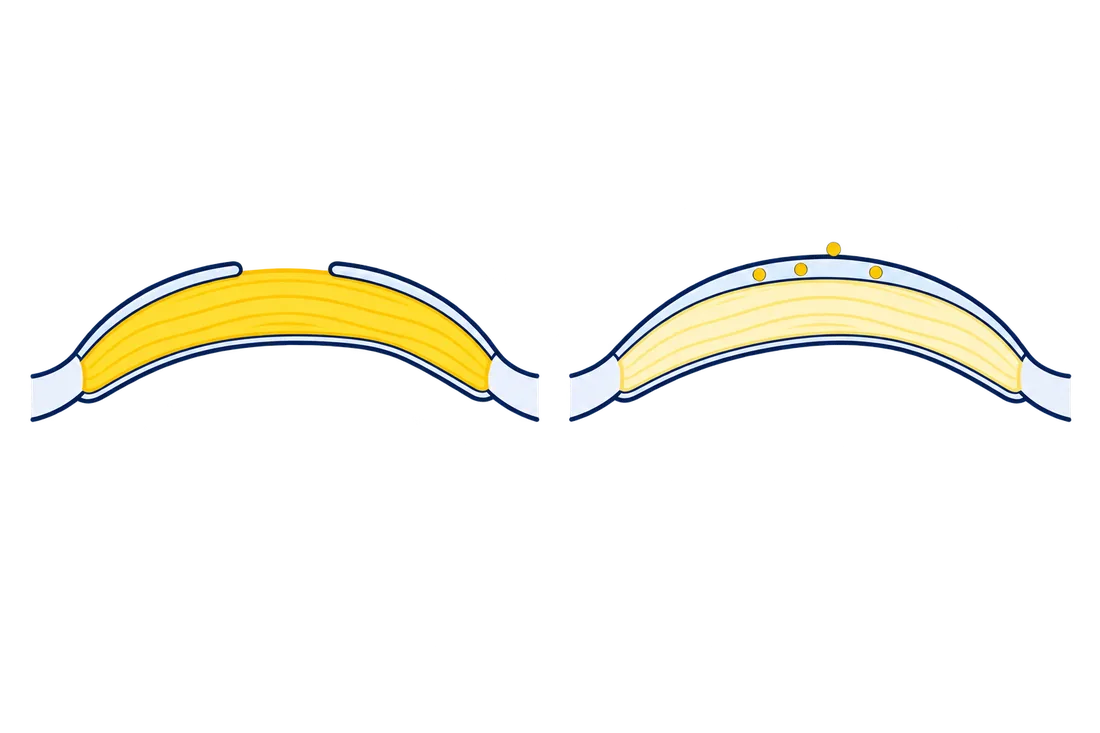
Outside the US, and in older studies, “epi-on” covers several different protocols. Results from one don’t automatically apply to another.
For the epithelium-off procedure, scroll through epi-off cross-linking step by step.
Side by side: the two US-approved systems
| Epi-off: Photrexa + KXL[1] | Epi-on: Epioxa + O2n[2][3] | |
|---|---|---|
| US approval | 2016 | October 17, 2025 |
| Approved for | Progressive keratoconus, and corneal ectasia after refractive surgery | Keratoconus |
| Ages | Safety and effectiveness not established below 14 | Adults and children 13 and older |
| Surface layer | Removed | Left in place |
| Thickness rule | Light only if the cornea is at least 400 microns (swelling drops may be used to reach it) | No light if the cornea is under 325 microns |
| Extra oxygen | No | Yes, through goggles |
| Riboflavin drops | Every 2 minutes for 30 minutes, then during the light treatment | Two steps: 4 minutes, then 6 minutes |
| Ultraviolet time | 30 minutes, continuous | 11 minutes 6 seconds, pulsed |
| Pregnancy | Should not be performed | Should not be performed |
One wording difference is worth knowing: the Photrexa label says “progressive keratoconus”, while the Epioxa label says “keratoconus”. That is the label text. It isn’t clinical guidance on treating keratoconus that isn’t getting worse; whether yours is progressing is a question for your surgeon and your scans. See how to read your keratoconus scan.
A 2026 change. In January 2026, Photrexa’s maker, Glaukos, notified the FDA that it would stop manufacturing the Photrexa cross-linking kit as of July 2026, and the FDA lists it as discontinued.[12] The comparison and the trial results on this page are unchanged, but which products a clinic can offer may change. Ask your surgeon which product they use.
Do they work equally well?
This is the question most people ask, and the honest answer is that the evidence is not strong enough to say one is better.
- Cochrane review, 2021. It pooled 13 randomized trials with 723 eyes comparing epi-on and epi-off methods. It found no important difference in the steepest corneal reading (Kmax) at 12 months or later, but rated that evidence “very low certainty”, and concluded it “remains unknown” whether epi-on or any other approach has an advantage.[4] These trials came before the oxygen-enriched US epi-on system.
- Meta-analysis, 2024. It included 27 studies with 1,622 eyes. At 12 months there was no significant difference in corrected vision or Kmax. Uncorrected vision was slightly better after epi-off, and epi-off thinned the cornea slightly more, by about 3.23 microns on average. The authors called both effective and asked for longer-term comparisons.[5]
- The Epioxa trials. Both were randomized against a sham (fake) treatment, not against epi-off. In Study 1 (279 treated eyes), the difference in Kmax between cross-linking and sham was -1.0 diopter at 6 months and -1.1 at 12 months. In Study 2 (312 eyes), it was -0.6 at 6 months and -1.0 at 12 months.[3] The published report of Study 2, which enrolled people aged 13 to 51, found no serious eye side effects.[6]
- The Photrexa trials. Also sham-controlled. Kmax flattened by 1.6 diopters at a year in keratoconus eyes treated with cross-linking, while the untreated eyes kept progressing.[7]
Because the two approved systems were each tested against a sham, and in different trials, their numbers can’t be set side by side as a contest. No head-to-head trial of Epioxa and Photrexa has been published that we could find.
Age mattered in the Epioxa trials. In Study 1, people under 29 showed a 2.0 diopter difference from sham at 6 months, partly because untreated eyes in that age group got worse; people 29 and older “did not experience improvement at month 6 in either arm”. In Study 2, older people improved about as much as younger people with treatment, but their untreated eyes worsened less, so the measured benefit was smaller.[3] Ask your surgeon how your age affects the benefit you can expect.
Accelerated, standard and other protocols
Epi-on or epi-off is only one of the ways cross-linking protocols differ. They also vary in how strong the ultraviolet light is and for how long, whether it’s continuous or pulsed, and whether the treatment is shaped to the cone. Different clinics, countries and products (often known by brand names) combine these in different ways, which is why the name of a protocol tells you less than the details.
- Standard (the “Dresden” protocol). The original epi-off method uses lower-intensity light for a longer time. The US Photrexa protocol gives 30 minutes of continuous light.[1]
- Accelerated. Stronger light for a shorter time, aiming at a similar total dose. In one registry, for example, standard meant 3 mW/cm² for 30 minutes and accelerated meant 9 mW/cm² for 10 minutes.[15] The US Epioxa system also uses a shorter, pulsed light treatment.[3]
- Customized. Some surgeons vary the dose across the cornea to target the cone. We didn’t find enough comparative evidence on these to summarize.
Does it matter? A meta-analysis of six randomized trials found accelerated and standard cross-linking stopped progression about equally at a year. Standard gave a slightly better gain in best-corrected vision, which the authors said may not be clinically significant, and no difference in the steepest corneal reading.[13] A broader meta-analysis of 22 studies (1,158 eyes) found both strengthened the cornea; standard did slightly better on some measures, and accelerated thinned the cornea less.[14] In a registry of 176 eyes followed for five years, both were safe and effective, but standard produced greater improvements in vision and corneal steepness.[15]
So the protocol may make a modest difference, and the evidence doesn’t single one out for everyone. For the trials, the FDA status of each protocol and what to ask, see accelerated vs standard cross-linking. Ask your surgeon which protocol they use, why, and whether your corneal thickness or age changes the choice.
Pain and recovery
A 2021 review links pain after cross-linking mainly to injury of the corneal nerves, and to a lesser extent to inflammation. It found epi-on is associated with less pain in the first days, but that the difference in pain scores and painkiller use disappears after the first few days. It also found no single pain-control approach considered superior.[8]
So epi-on is not painless. The Epioxa label says there may be discomfort in the treated eye; in the Photrexa trials, eye pain was reported in 17% of treated keratoconus eyes.[3][1] The labels themselves warn that side-effect rates from different trials can’t be compared directly.
The day, the pain plan, and the warning signs are covered in what to expect from corneal cross-linking.
Haze and other side effects
Haze is a temporary cloudiness in the cornea. The Cochrane review found moderate-certainty evidence that epi-off caused slightly more haze or scarring than epi-on.[4]
- Photrexa label: haze was the most common side effect in keratoconus eyes.[1]
- Epioxa label: redness of the white of the eye was the most common reaction, in 31% of 389 treated eyes; haze, light sensitivity, punctate keratitis and eye pain were among reactions in 5% to 25%.[3] In the published Study 2, punctate keratitis (tiny spots of surface damage) was the most common adverse event: 6.5% with cross-linking vs 1.8% with sham.[6]
Thin corneas
The two labels set different thickness rules for switching on the light: at least 400 microns for Photrexa (with swelling drops used to reach that if needed), and not under 325 microns for Epioxa.[1][3] That is all the labels say. They don’t establish that epi-on is the right choice for thin corneas, so ask your surgeon how your thinnest reading affects each option.
Children and teens
Epioxa is approved for patients 13 and older. The Photrexa label says safety and effectiveness have not been established below age 14.[2][1] If a plan won’t approve cross-linking for a younger child that the specialist recommends it for, ask whether these label ages are the reason. Treating outside them is the specialist’s judgment, and the clinic can tell you whether an appeal is worth making. See appealing a denied claim.
In a pooled analysis of studies in children, keratoconus progressed after epi-off cross-linking in 9.9% of 1,508 eyes, with wide differences between studies.[9] We found no equivalent pooled figure for epi-on in children. More on young patients is in keratoconus in children.
Both eyes, and timing between them
In the Epioxa trials, the second eye was treated between 1 week and 3 months after the first.[3] One older US study of a different, non-approved epi-on protocol treated both eyes on the same day in 95 people,[10] but that protocol’s results don’t transfer to Epioxa or Photrexa. Ask your surgeon what they recommend and why.
Getting back into your lenses
Neither label gives a timeline for returning to contact lenses. With epi-on, a bandage lens is placed at the end of treatment;[3] with either method, your surgeon decides when your own lenses can go back in. Plan for a refit: in a small study of scleral lens wearers who had epi-off cross-linking, 61% of eyes needed a fit or power change over the following year.[11] See cross-linking and scleral lens timing and after cross-linking.
Cost and coverage
Coverage differs by plan and is still settling for the newer epi-on system, so we don’t make claims about what any insurer covers. Ask your plan which procedure it covers, whether it needs documented progression, and whether prior authorization is required. If you’re turned down, see appealing a denied claim. Our page on cross-linking and insurance covers what published insurer policies ask for, including separate criteria for epi-on.
Questions to ask your surgeon
- Is my keratoconus progressing? What do my serial scans show?
- Which method do you offer, and why do you recommend it for my eye?
- How thick is my cornea at its thinnest, and does that rule either method in or out?
- How does my age change the expected benefit?
- What should I expect for pain and time off?
- Will you treat one eye or both, and how far apart?
- When can I go back into my lenses?
- Which procedure code will you submit to my plan, and will you request prior authorization?
Common questions
Is epi-on as effective as epi-off?
We don't know for certain. Reviews of trials comparing the two found no clear difference in corneal steepness at a year, but rated the evidence low or very low certainty. The approved US epi-on system was tested against a sham treatment, not against epi-off, so its trials can't answer the question either.
Is epi-on painless?
No. It tends to hurt less in the first days because the surface layer isn't removed, but a review found the difference in pain and painkiller use disappears after the first few days. Both US labels say there may be discomfort.
Can teenagers have epi-on cross-linking?
The US epi-on system (Epioxa) is approved for adults and children aged 13 and older. The epi-off label (Photrexa) says safety and effectiveness weren't established below age 14. Your child's surgeon will weigh age, scans and corneal thickness.
My cornea is thin. Should I ask for epi-on?
Both labels set a thickness limit for switching on the ultraviolet light: at least 400 microns for epi-off (after swelling drops if needed) and no less than 325 microns for epi-on. That is a label threshold, not evidence that epi-on is the right choice for thin corneas. Ask your surgeon what your thinnest reading means for each option.
Will my insurance cover epi-on?
Coverage rules differ by plan and are changing as the newer system rolls out, so we can't answer for your plan. Ask your plan which procedure codes it covers, whether it needs proof of progression, and whether prior authorization is required.