
Why this matters
With good scleral lenses, many people with keratoconus see clearly all day. Then the lenses come out, and the world goes back to blur and ghosting. People in patient communities often describe the same moments: getting up in the night, a baby crying, the dog needing to go out, a smoke alarm, a hurricane warning, or a power cut just as they were about to remove their lenses.
Most of our pages are about the hours your lenses are in. This one is about the hours they’re out.
Backup glasses
A pair of glasses is the one thing that helps in almost every situation on this page. The FDA advises every contact lens wearer to always have a backup pair of glasses with a current prescription, in case of problems with the lenses.[1]
Why they don’t see as well as your lenses. With an irregular cornea, glasses correct only part of the blur. At one US academic eye clinic, people with keratoconus seen in 2020 averaged 0.35 logMAR in glasses with their full glasses prescription (about 20/45), against 0.13 (about 20/27) in contact lenses.[3] So expect backup glasses to take the edge off, not to match your lenses. That is still enough for the walk to the bathroom, a night feed or a fire exit.
Your lens prescription is not a glasses prescription. A scleral lens does its focusing over a layer of saline that fills in the uneven cornea, so its power doesn’t carry over to glasses. Backup glasses need their own eye test with your lenses out. An irregular cornea is also harder to measure: in one study that repeated an automated refraction on three different days, results varied more in people with keratoconus than in healthy eyes.[4] Ask your eye doctor when to have that test, since blur right after removal can skew it. The comparison of scleral lenses vs glasses for keratoconus goes into what glasses can and can’t do.
Ask for it at a routine visit. “Can I have an up-to-date glasses prescription, even if glasses won’t match my lenses?” is a fair request. Glasses that go over your lenses for reading are a different pair: see wearing glasses over scleral lenses.
Set up your bedside
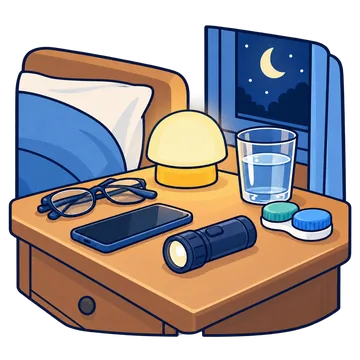
- Glasses within reach. Keep your current glasses where you can find them by touch: the same spot every night. The FDA advises contact lens wearers to always have a backup pair of glasses with a current prescription.[1] Even an imperfect pair helps you find the door and your phone.
- A light you can find blind. A touch lamp, a light switch you can reach from bed, or a small flashlight in a fixed place.
- A clear route. A night-light in the hall and bathroom, nothing on the floor, and the same layout every night.
- Your phone in the same spot, charged, with your emergency contacts and lens details saved. Our lens card can save your fitter’s number and lens details on your phone.
Don’t keep a lens in “just in case.” Some people leave one lens in overnight so they can see if something happens. We don’t recommend it: the FDA warns that sleeping in lenses not made for overnight wear may increase the chance of infection or irritation.[1] See can you sleep in scleral lenses? Your glasses are the night-time plan.
Babies, toddlers and night-time care
Parents describe night feeds, diaper changes and settling a toddler with their lenses out. What helps:
- Glasses on before you pick the baby up, and a dim light on the route to the cot or crib.
- Supplies at the changing station that you can find by touch.
- If a small child scratches or pokes your eye, don’t put a lens back in until it feels normal. If it’s painful, red or your vision is worse, see eye pain: when to get help.
- If you’re exhausted, it’s easy to doze off in your lenses. Take them out before you sit down for a feed you might fall asleep during.
Fires and evacuations: leave without your lenses
In a fire, every second counts.[7] Don’t stop to put lenses in, and don’t go back for them. Grab your glasses only if they’re right beside you, and get out. Ready.gov advises practising a home fire escape plan twice a year and knowing two ways out of each room.[7] Practise yours with your glasses off, so you know you can do it.
For an evacuation you can see coming, such as a hurricane or wildfire warning, there’s time to plan:
- If your lenses are in and comfortable, many wearers keep them in for the journey, with the kit and glasses in their bag, and take them out as soon as they reach somewhere clean with good light. Ask your fitter ahead of time how long is too long for your eyes.
- If your lenses are out, go in your glasses. Don’t try to insert lenses in a rush, in bad light, with unwashed hands.
Power cuts
Removing lenses in the dark is where mix-ups happen.
- Keep a headlamp or a flashlight with spare batteries where you remove your lenses. Ready.gov lists a flashlight and extra batteries in a basic emergency kit.[5] A headlamp keeps both hands free.
- Keep to your usual order: same eye first, each lens straight into its own marked side of the case. See right and left lenses mixed up.
- If the water supply might be affected, use only sealed sterile saline and the solution your fitter approves. Never rinse lenses or cases with tap water.[2]
- In a long outage in hot or freezing weather, see can heat or freezing damage scleral lenses?
Your go-bag
Ready.gov’s emergency kit list includes prescription eyeglasses and contact lens solution, and its advice for people with disabilities includes extra eyeglasses and contact lenses.[5] [6] For scleral lenses, that means:
- Sealed, unopened single-use saline vials you fill with, within their dates.
- Your disinfecting solution in its original bottle, and a clean case.
- Both plungers: a spare removal plunger and inserter.
- Your glasses, or a spare pair.
- A light: a headlamp or small flashlight.
- Your lens details and your fitter’s contact, on paper and on your phone. Our printable emergency card tells emergency staff how to remove a scleral lens.
- Any eye drops you use, if your fitter has approved them.
Check the bag each season: replace anything expired or opened, and restock after you use it. Our emergency kit guide covers the smaller everyday pouch.
Show someone how to help
Ready.gov advises building a support network of people who can help you in a disaster.[6] At home, that can be simple:
- Show a partner, family member or housemate where your glasses, kit and go-bag live.
- Make sure they know you may not see well without your lenses, and how they can guide you.
- If they might need to help with your lenses, see helping someone else with their lenses, ideally with training from your fitter.
If you live alone, tell a neighbor or friend, and keep your emergency contacts on your phone’s medical ID.
If your vision stays limited even with lenses, the practical help that exists for low vision covers rehabilitation and benefits, and scleral lenses with other eye and health conditions covers the conditions that can add to it.
Questions to ask your fitter
- Can I have an up-to-date glasses prescription, even if glasses don’t give me my best vision?
- If I have to keep a lens in longer than usual, for travel or an evacuation, what’s safe for my eyes?
- Can I have a spare pair of lenses or a backup pair kept somewhere safe?
- What should I do if I can’t get my usual saline for a while?
Common questions
Can I leave one lens in overnight so I can see if something happens?
No. Take your scleral lenses out before any sleep, including a short nap: sleeping in lenses raises the risk of eye infection. Keep your glasses within reach instead. The only exception is supervised treatment a doctor prescribes for a specific eye condition. See can you sleep in scleral lenses?
My glasses are old and don't help much. Are they still worth keeping by the bed?
Yes. Even glasses that only take the edge off help you find the door, the light switch and your phone. The FDA advises contact lens wearers to keep a backup pair of glasses with a current prescription, so ask your eye doctor at your next visit whether an updated pair would help.
I'm a firefighter, nurse or on-call worker. How do others manage night callouts?
Wearers in on-call jobs describe keeping a full kit at work, using glasses for the first minutes of a callout and putting lenses in once they can, and practising until insertion is quick. Never sleep in your lenses at the station. If your job has vision standards, talk to your occupational health team and your fitter about a plan that works for both.
What if I have to remove my lenses in the dark?
Use a headlamp or a phone light propped up so both hands are free, and stick to your usual order: same eye first, each lens straight into its own marked side of the case. If you can't see well enough to remove a lens safely and it's comfortable, it's usually better to wait for light than to fumble. If it hurts, remove it and call your eye doctor.