
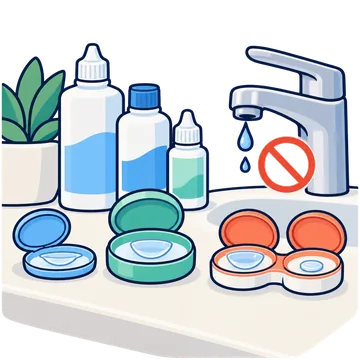
Most of this site is about scleral lenses. But many people with keratoconus wear a small corneal rigid gas permeable (RGP) lens, a hybrid lens, or a piggyback system, sometimes for decades. People in keratoconus communities often ask the same care questions: which solution goes with which lens, whether rinsing with tap water is really a problem, and how to look after two lenses in one eye.
Brands on this page are named as examples, not endorsements. Your fitter’s instructions and your product’s label come first.
The rules that apply to every lens
These come straight from the FDA’s contact lens advice, and they hold whatever type of lens you wear:[1]
- Wash and dry your hands before you touch a lens.
- Use the care products your eye care professional recommends, and follow the label.
- Rub and rinse your lenses as your fitter directs.
- Use fresh solution every time. Never top off or reuse old solution in the case.
- Keep lenses away from all water: tap, bottled, distilled, lake or ocean.
- Never use saliva or homemade saline.
- Don’t pour solution into smaller travel bottles, which can affect sterility.
- Rinse the case with fresh solution, let it air dry, and replace it every three months or as your fitter says.
- Don’t use a solution past its expiry or discard date.
If you’re thinking about changing products, talk to your fitter first. The FDA specifically advises against switching your lens-care system without checking.[3]
Why tap water is the one rule not to bend
Some long-time RGP wearers were taught to rinse their lenses or case under the tap, and a few say a clinic told them it was fine. It isn’t. The FDA links water exposure to Acanthamoeba keratitis, a corneal infection it describes as resistant to treatment and cure.[1]
The research points the same way. In a US study comparing 88 soft lens wearers who developed Acanthamoeba keratitis with 151 who didn’t, rinsing or storing lenses in tap water and rinsing the case with tap water were all more common in the people who got the infection.[7] A UK study of 83 people with the infection and 122 without found higher odds of infection in rigid lens wearers than in people who used daily disposable soft lenses.[8] These are observational studies, so they show a link, not a precise risk for any one person. But the habit is easy to change, and the infection is not easy to treat.
Rigid lenses that have been rinsed with tap water should be cleaned and disinfected properly before you wear them again. If your eye becomes painful, red or sensitive to light, take the lens out and call your eye doctor the same day.
Corneal RGP lenses
A corneal RGP is a small rigid lens that sits on the cornea. It needs a care product made for rigid gas permeable lenses. Unique pH, for example, is cleared by the FDA for cleaning, rinsing, disinfecting and conditioning rigid lenses.[4] Boston Simplus and other GP multipurpose solutions do the same kind of job, and some peroxide systems are labeled for rigid lenses as well. Our page on GP multipurpose solutions explains conditioning, two-bottle systems and what wearers say about each product. If you use peroxide, read how hydrogen peroxide works first.
A typical routine looks like this, but follow your own fitter’s version:
- Wash and dry your hands.
- Take the lens out over a clean towel or a closed sink.
- Rub each side with a few drops of the cleaner or multipurpose solution.
- Rinse with the product your label or fitter specifies. That’s the solution itself or sterile saline, never water.
- Store in a clean case filled with fresh solution for at least the soak time on the label.
- In the morning, empty the case, rinse it with fresh solution and leave it open to air dry.
Removal. Many RGP wearers learn to take lenses out with their eyelids or a blink. Others use a small suction remover made for corneal RGPs. These small removers are not the same as the larger plungers used for sclerals, so use the one your fitter gave you, and only on a lens you can see is on the eye.
Wind, dust and pop-outs. A small lens can be dislodged by wind or a hard blink, and a speck of dust under it can be very painful. If that happens, take the lens out, clean and rinse it with your usual product, and put it back in only if your eye feels normal. Wraparound glasses help many people outdoors. If pop-outs or debris are frequent, mention it at your next visit: the fit may need a change.
Hybrid lenses
A hybrid lens has a rigid center and a soft skirt around the edge. That soft skirt changes the care rules. The FDA clearance for UltraHealth hybrid lenses for keratoconus says they may be disinfected only with a chemical disinfecting system compatible with both soft (hydrogel) and rigid gas permeable lenses.[5] SynergEyes hybrid lenses are cleared for chemical, not heat, disinfection, as recommended by the eye care professional.[6]
In practice:
- Check the label for both lens types. Many multipurpose solutions are made only for soft lenses, and many GP solutions only for rigid lenses. A hybrid needs one labeled for both, or one your fitter has specifically approved for your lens.
- No heat. Don’t boil or heat-disinfect a hybrid.
- Handle the skirt gently. The soft edge can tear, and a torn or nicked skirt can be uncomfortable or scratch. Don’t wear a lens with a damaged skirt: call your fitter.
- Removal. Hybrids are taken out differently from rigid lenses. Follow the technique your fitter taught you, and ask before using any suction tool on a hybrid.
- Replacement. Hybrids are replaced on a schedule your fitter sets. Write it down, because a soft skirt ages even when the center looks fine.
Piggyback systems
A piggyback system is a soft lens worn under a rigid lens, usually to make the rigid lens more comfortable or stable. It means caring for two different lenses in each eye, and the products often aren’t interchangeable.
- The soft lens. If it’s a daily disposable, throw it away each night. If it’s reusable, it needs a solution labeled for soft lenses, in its own case.
- The rigid lens. It needs a solution labeled for rigid gas permeable lenses, in a separate case.
- Label the cases. Two cases per eye is easy to mix up, especially with poor vision. Different colors or a marker on the lids help.
- Order of insertion and removal. Your fitter will tell you which lens goes in first and comes out first. Write it down.
- Check before you buy. Ask your fitter which products are safe for both, in case a little solution from one lens ends up on the other.
Our comparison of scleral lenses and piggyback lenses explains why fitters choose each.
If you also wear scleral lenses
PROSE devices and impression-based lenses are scleral lenses too, so the scleral routine applies. The FDA clearance for EyePrintPRO, for example, describes it as a rigid gas permeable scleral lens that may be cleaned and disinfected with a chemical (not heat) care system.[9] If a clinic gives you its own product list, as specialty programs often do, follow that.
Some people wear an RGP in one eye and a scleral in the other, or keep old RGPs as a backup. Many of the same GP products work for both, because scleral lenses are rigid gas permeable lenses too. The difference is the fill: a scleral lens is filled with sterile, preservative-free saline before it goes in, never with a multipurpose or conditioning solution. See filling solutions and, if you’re thinking of moving to sclerals, switching after years of RGPs or hybrids.
Questions to ask your fitter
- Which exact products should I use for this lens, and can you write them down?
- Is my lens coated, and does that rule out any cleaners?
- How should I rinse before insertion: with the solution, or with sterile saline?
- How often should this lens be replaced?
- What should I do if a lens pops out when I’m away from home?
Common questions
My eye doctor told me years ago that rinsing my RGPs with tap water was fine. Is it?
No. Older care instructions sometimes allowed it, and some wearers say they were told it was fine more recently. The FDA's advice today is clear: no tap, bottled or distilled water on contact lenses, because water has been linked to Acanthamoeba keratitis. Rinse with the solution or sterile saline your fitter recommends, and if you're unsure, ask them to write your routine down.
Can I use my scleral lens solutions on my RGPs?
Often, yes, because scleral lenses are rigid gas permeable lenses too. GP multipurpose solutions and peroxide systems labeled for rigid lenses are used on both. Check the label and ask your fitter, especially if either lens has a coating.
Can I use a soft-lens multipurpose solution on my hybrid?
Only if your fitter and the product's label say it's suitable for hybrids, or for both soft and rigid lenses. Hybrid lenses are cleared for chemical disinfection with a system compatible with both lens types, and many soft-lens solutions aren't labeled for rigid materials.
Can I heat-disinfect or boil my lenses?
Not hybrids: their FDA clearance specifies chemical, not heat, disinfection. For any lens, use only the method on your care product's label and approved by your fitter.
How often should I replace my lens case?
The FDA says every three months, or as directed by your eye care professional. Replace it sooner if it's cracked or stained. With peroxide, use the new case that comes with every bottle: the FDA warns an old one may not neutralize the peroxide properly.
My RGP keeps popping out in the wind. Is that a care problem?
Usually it's a fit or blink issue rather than a care one, though a dirty or dry lens can make it worse. Wraparound glasses help many people outdoors. If it happens often, tell your fitter: a different design, a hybrid or a scleral lens may sit more securely.
Do PROSE, hybrid or EyePrintPRO lenses need a different cleaning routine?
Hybrids do, because of their soft skirt: they need a solution labeled for both soft and rigid lenses, and no heat. PROSE devices and impression-based lenses such as EyePrintPRO are rigid gas permeable scleral lenses, so the basic routine is the same as for other sclerals: rub, rinse, disinfect with a rigid-lens system, and fill with sterile preservative-free saline. Some are coated or come with specific products, so follow the written instructions from the clinic that made them and ask before switching anything.