

Cataract surgery removes the cloudy lens inside your eye and replaces it with a clear implant. Before surgery, your eye is measured, including the curve of your cornea, and those measurements set the implant’s power. Keratoconus doesn’t change the surgery much. It changes the measuring and the planning, and that’s where most of the extra questions come from.
People often ask about this later in life: some have worn rigid or scleral lenses for decades, and some only learn they have keratoconus at a cataract assessment. If you wear scleral lenses, our page on planning cataract surgery with scleral lenses covers lens-free time and the weeks without lenses in more detail.
What happens in the surgery
The 3D view at the top of this page shows each step.
A cataract is a cloudy area in the eye’s natural lens, the clear part behind the iris that helps focus light. Most come with age, as proteins in the lens break down and clump together.[14] A cataract can also give the lens a yellow or brown tint.[13] In surgery, after numbing drops, the surgeon uses tiny tools to cut into the eye, break up the cloudy lens and take it out, and then places the new artificial lens.[13] The lens sits in a thin capsule: the surgeon opens the front of it in a continuous circle (a capsulorrhexis), and the implant can then go inside the capsule, “in the bag.”[6]
Why the implant power is harder to get right
Standard implant formulas assume a regular cornea, with a fixed relationship between the curve of its front and back surfaces. A standard reading (keratometry) measures only the front surface and assumes the back follows, and an off-center cone distorts the readings themselves. Keratoconus breaks those assumptions, and the standard formulas often leave the eye more farsighted than planned.[1] Measuring the cornea is also harder: readings repeat less well, especially on very steep corneas, and an unstable tear film adds to the variation.[2]
How close the result lands depends a lot on how advanced the keratoconus is. A review of 14 studies (456 eyes) found that with the top-performing formulas, 83% to 94% of eyes with mild keratoconus ended within 1 diopter of the planned prescription. That fell to 51% to 57% in moderate keratoconus and 12% to 48% in advanced keratoconus.[3]
Formulas built for keratoconus help. A 2025 review highlights two: Barrett True-K for keratoconus, and Kane with its keratoconus adjustment.[1] A 2025 analysis pooling 9 studies (623 eyes) ranked Barrett True-K highest when the back surface of the cornea was measured directly, with a possible edge for Kane’s keratoconus version in severe keratoconus.[4] A 2026 analysis of 7 studies (530 eyes) also put these two formulas ahead of the standard ones, while warning that the data are limited and the rankings exploratory.[5]
The target matters too. Many people with keratoconus have been nearsighted all their lives, and a review notes they were particularly unhappy with farsighted surprises. Surgeons have often aimed for a nearsighted result for that reason.[1] Ask your surgeon what target they’re planning, and what happens if the result is off.
Leaving your lenses out before the measurements
Contact lenses can change the shape of the cornea for a while, which can skew the measurements, so surgeons ask you to stop wearing them before your eye is measured. A 2025 review says about three weeks out of soft lenses is generally enough. For rigid lenses it describes a common rule of at least 1 month out for every decade of wear, but says the exact time needed hasn’t been established or tested against shorter periods.[1] Another review says rigid lens wear should stop for at least 1 to 2 weeks, that because cataract surgery is planned, the surgeon can wait until repeat readings agree, and elsewhere advises at least 1 month out of lenses before the measurements.[6]
We didn’t find a study that sets a lens-free time for scleral lenses, which vault over the cornea instead of resting on it. Your surgeon will tell you how long to leave your lenses out. Make sure the office knows exactly what kind of lens you wear, and say early if you can’t function without them.
Toric implants: who they suit
A toric implant corrects regular astigmatism, the even, predictable kind. It can’t correct the irregular astigmatism that keratoconus causes.
- They can work in stable keratoconus. A review of 8 studies (135 eyes) found toric implants reduced astigmatism by 2.28 diopters on average and improved vision with and without glasses. Most implants rotated 10 degrees or less, one needed repositioning, and complications were infrequent and mostly minor.[7]
- Severity and shape decide. A review of cataract surgery in keratoconus says standard (monofocal) implants are the better choice in advanced keratoconus, and toric implants can be used in mild, stable keratoconus.[6] Another advises basing the decision on how severe the keratoconus is, how regular it is, and whether the cone is central.[8]
- If you’ll still wear a rigid or scleral lens. One review advises against a toric implant when you’ll need irregular astigmatism corrected afterward, though it’s an option in selected cases.[8] One suggests toric implants particularly for people who don’t plan to wear contact lenses after surgery.[1]
A toric implant also has to line up with the astigmatism it corrects, and one review warns that toric implants are at risk of rotating out of line, especially in long eyes with a large capsule.[6]
In a study of 36 eyes with corneal ectasia, combining several measurements improved how well the toric correction was predicted.[9] Ask your surgeon how they’ll measure your astigmatism, and whether it’s stable and repeatable enough for a toric implant.
Standard, multifocal, or something else
A review of implants for near vision describes multifocal implants as unsuitable for eyes with irregular corneas, such as keratoconus or a corneal transplant.[10] So most people with keratoconus are offered a standard (monofocal) implant, sometimes toric.
There are other ways to get a range of vision. With monofocal implants, monovision (one eye set for distance and the other for near) is one approach.[10] Small-aperture implants have been explored for people with severe keratoconus who can’t wear contact lenses and aren’t suited to a toric implant,[1] but a 2026 review says the keratoconus-specific evidence for them is limited.[11] If you wear scleral lenses, near vision can also be handled with readers over your lenses; see do I need reading glasses with scleral lenses?.
If your keratoconus is still changing, or you’ve had a transplant
Reviews advise delaying cataract surgery until keratoconus is stable whenever possible, and considering cross-linking if it’s shown to be progressing. Ring segments may be used to improve the corneal shape, and advanced thinning or scarring may need a transplant first.[1] Stabilizing the cornea before the measurements can make the result more predictable.[8]
If you’ve had cross-linking, one review recommends calculating the implant power at least 6 months afterward, based on a study in which the prescription had settled by 6 months.[6] More on the procedure is in what to expect from corneal cross-linking.
If you already have a corneal transplant, cataract surgery can still go well. In a small study of 24 eyes with grafts for keratoconus, vision and the spherical part of the prescription improved after cataract surgery, astigmatism didn’t change, and graft survival was excellent.[12] Ask your surgeon how the surgery might affect your graft; see living with a corneal transplant.
Lenses after cataract surgery
Cataract surgery doesn’t smooth an irregular cornea. One review advises checking for irregular astigmatism afterward and providing updated rigid or scleral lenses, which can help people reach their clearest vision.[8] One review advises telling patients that their contact lens power will change and they’ll need a new pair.[6] Plan and budget for a refit, and let your surgeon and fitter decide together when your eye is ready. Our page on scleral lenses after cataract surgery covers restarting and what Medicare covers.
Questions to ask your surgeon
- How advanced is my keratoconus for this purpose, and is it stable?
- Which formula will you use, and what target are you aiming for?
- How long should I leave my lenses out before measurements, and will you measure more than once?
- Would a toric implant help me, or should we plan on a rigid or scleral lens afterward?
- What happens if the result is off target?
- Should I have cross-linking first, and how long should I wait after it?
- If I have a graft: how might surgery affect it?
- Can you talk with my contact lens fitter before we choose the implant?
See it in 3D
See cataract surgery step by step in a 3D model, one step at a time as you scroll.
Scroll through the steps
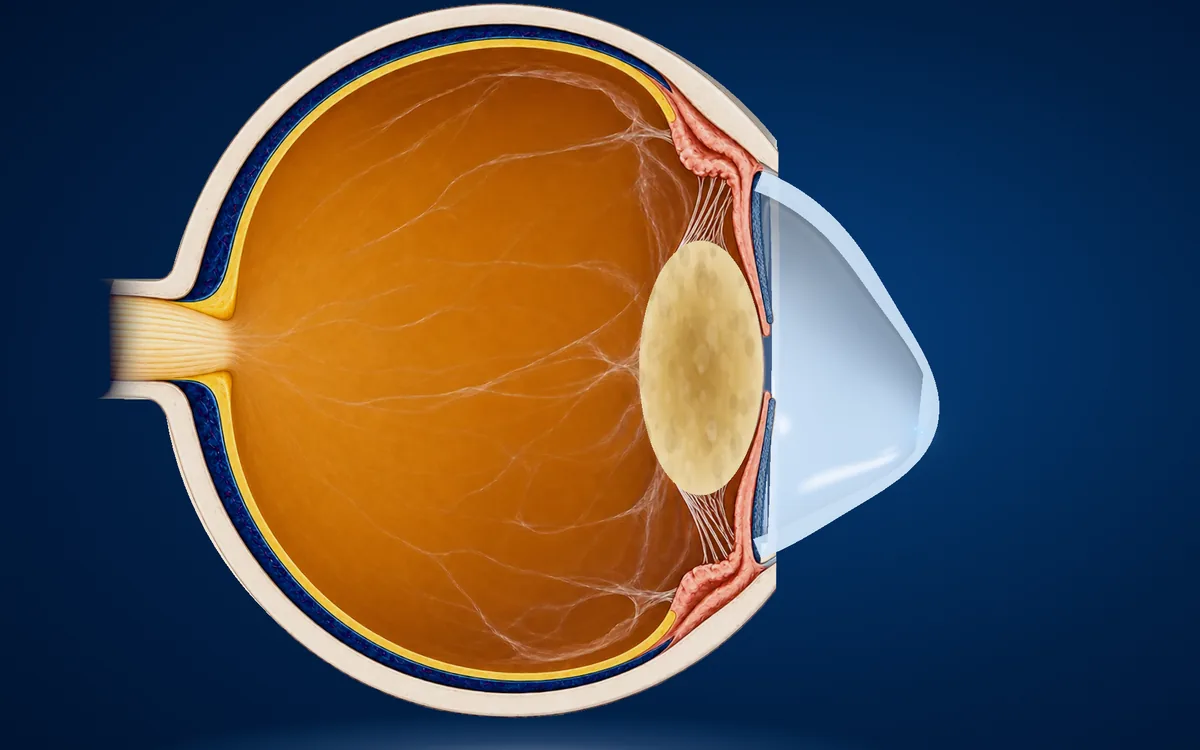
Illustration, not to scale. Steps simplified. Your surgeon’s technique may differ.
Common questions
Will cataract surgery get rid of my keratoconus?
No. Cataract surgery replaces the cloudy lens inside your eye. Keratoconus is in the cornea, the clear window at the front, and the surgery doesn't change its shape. The implant can correct some of your prescription, but if your vision depends on a rigid or scleral lens now, there's a good chance you'll still need one afterward, usually with a new prescription.
Can I have a multifocal implant so I don't need reading glasses?
Usually not. A review of implants for near vision describes multifocal implants as unsuitable for eyes with irregular corneas, including keratoconus and corneal transplants. Other approaches include setting one eye for distance and the other for near, or a small-aperture implant, though evidence for small-aperture implants in keratoconus is limited. Ask your surgeon what's realistic for your eyes.
My keratoconus was found at my cataract assessment. Should I have cross-linking first?
Ask your cornea specialist. Reviews advise waiting until keratoconus is stable before the measurements whenever possible, and considering cross-linking if it is shown to be progressing. One review recommends calculating the implant power at least 6 months after cross-linking. Many people diagnosed later in life have keratoconus that isn't changing, so the first step is usually scans over time to check.
Are both eyes done at the same time?
Usually not. The National Eye Institute says that when both eyes have cataracts, each eye is done at a separate time, usually about a month apart. With keratoconus, that also gives your surgeon a chance to see how the first eye turned out before planning the second.